(This post was originally written 11th May, 2015. I heard the first bobolinks six days later.)
Even now, the bobolinks are powering their way north, riding the massive currents of air that well up from the Equator. Each bird is a mere 35 grams of flesh, bone and feathers – the weight of three Oreo cookies – yet wings more than 20,000 kilometres on an annual migration to Argentina. A few, I hope, will return to the fields and pastures around my farm.
When they settle in, those fields will come alive with birdsong. The males soar and dip overhead, twittering and burbling to entice mates and mark out territory. Once mates are found and nesting sites selected, the males eye me from their perch on fence posts and wires as I trudge out to check the sheep and cattle. They wear a backwards tuxedo – black on the front, cream and white on the back – and sing a sort of avian bebop. Sometimes, I see them clutching a wriggling armyworm in their beaks.
But this summer soundtrack is falling silent, as agricultural grasslands decline in my region of eastern North America, and modern hay-harvesting techniques reduce the number of nestlings that survive into the next migration.
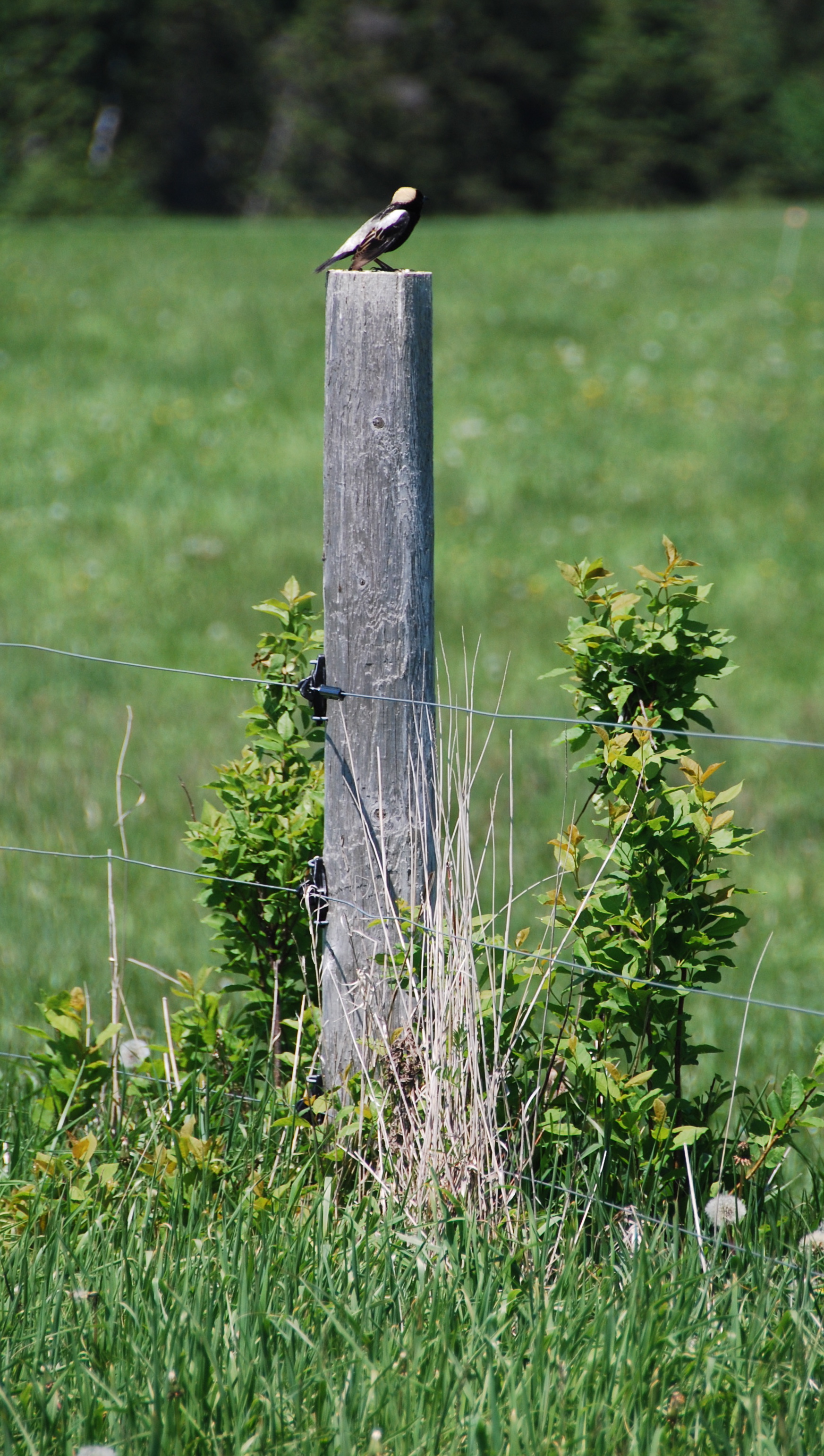
Male bobolink, with distinctive yellow cap and white “backwards tuxedo” markings across his back.
Ontario, my home province, lost about 77 per cent of its bobolinks between 1970 and 2011, and 62 per cent of its Eastern Meadowlarks, according to the province’s Recovery Strategy for the two species. (Ministry of Natural Resources, 2013.) In part, this is due to vast changes taking place on the agricultural landscape. The countryside is undergoing what one old-time cattle farmer called the “cash crop revolution,” a great plough-up that is shifting the landscape from grass and cereal grains towards corn and soybeans. Since the mid-60s, something like 1.5 million acres of hay and pasture land have disappeared from Ontario. That’s a dramatic and inhospitable change for the wild species that live in and around the grasslands, but one likely unnoticed by most people, for whom corn and hay are all just roadside “farm fields.”
Urban sprawl is another part of the problem. My grandmother recalled meadowlarks singing from the fenceposts around her farm in Burlington. Back then you could look across the fields to the limestone spine of the Niagara Escarpment to the northeast, and then south to the sparkling blue of Lake Ontario. Now that farm is covered by homes and streets. It represents a small fraction of the 150,000-plus acres of land paved over in the Toronto area since the mid-1970s.
You won’t find bobolinks around there much any more, just as you won’t find them in land covered by corn or soybeans. These birds are what ornithologists call “obligate” grassland species. That is, they are “obliged” to live on a certain landscape, preferably an extensive grassland that provides cover for nests and insects for dinner, without too many roads and humans, or too many tall trees and the predatory birds that perch in them.
Now, with most of Ontario’s natural grasslands lost, farm fields provide the next best option, and this has some farmers concerned. Both bobolinks and meadowlarks have been listed as “threatened” species, a designation that gives the province the power – so far unused – to regulate key farm activities, including how we cut hay and pasture livestock, in order to protect the birds.
Not surprisingly, the prospect of government intruding into the hayfield gets some worked up. Under the heading “Latest threat to farming – bobolink and biodiversity zealots” a writer in a farm paper branded the bobolink “a plump, mostly black bird that eats too much and can’t sing,” a bird with “an ugly face and a wimpy spiked tail.”
That’s so over the top, I suspect the writer was having a bit of fun. Yet it’s true that many farmers, fearful of the terms of Ontario’s Endangered Species Act, see the bird as a potential nuisance, another costly imposition on farm community.
I think they’ve got that wrong, and I’ll argue the case in a future post. The bobolink is an unacknowledged ally for grass-based livestock farmers, and perhaps their neighbours who grow grain.
Besides, I’d hate to have my workplace deprived of bird song, and lose the natural soundtrack of the fields. Any day now, the skies will fill with song. Let’s hope they never fall silent.
 Empire of grass