Summertime, and the livin’ is easy…
People seem to enjoy doing things that are hard. You can pay someone to help you climb Everest, run marathons, or organize your walking tour of the Camino de Santiago. No doubt those are all fulfilling activities, but our summer is spent in our own exercise in difficulty, humility and exhaustion: attempting to turn green grass into dried hay. To date, no paying customers have offered to join us during this six-week struggle with the weather, mechanical breakdown and family dysfunction we call hay season. Could it be we’re not marketing it very well?
Adapted from a 2013 column I wrote for the Ontario Farmer — the province’s major weekly farm newspaper — here’s all the fun you non-haying types are missing:
For years now, the end of hay season is marked by the sound of my wife, Sue, striking her head on a two by four. I know when she does this, because the impact makes the barn’s tin roof reverberate in a drawn-out tone, like a gong. It’s both pretty, and painful.
Somewhere, some experimental music type may well be making music with sheet metal and trusses, but this is not Sue’s intent. Instead, she’s wedged among the trusses of the barn, pulling bales off the elevator, and flinging them towards me. I’m near the peak of the roof, jamming the last few bales in place. Like other obsessive farmers, I can’t stand to let prime real estate go unfilled.
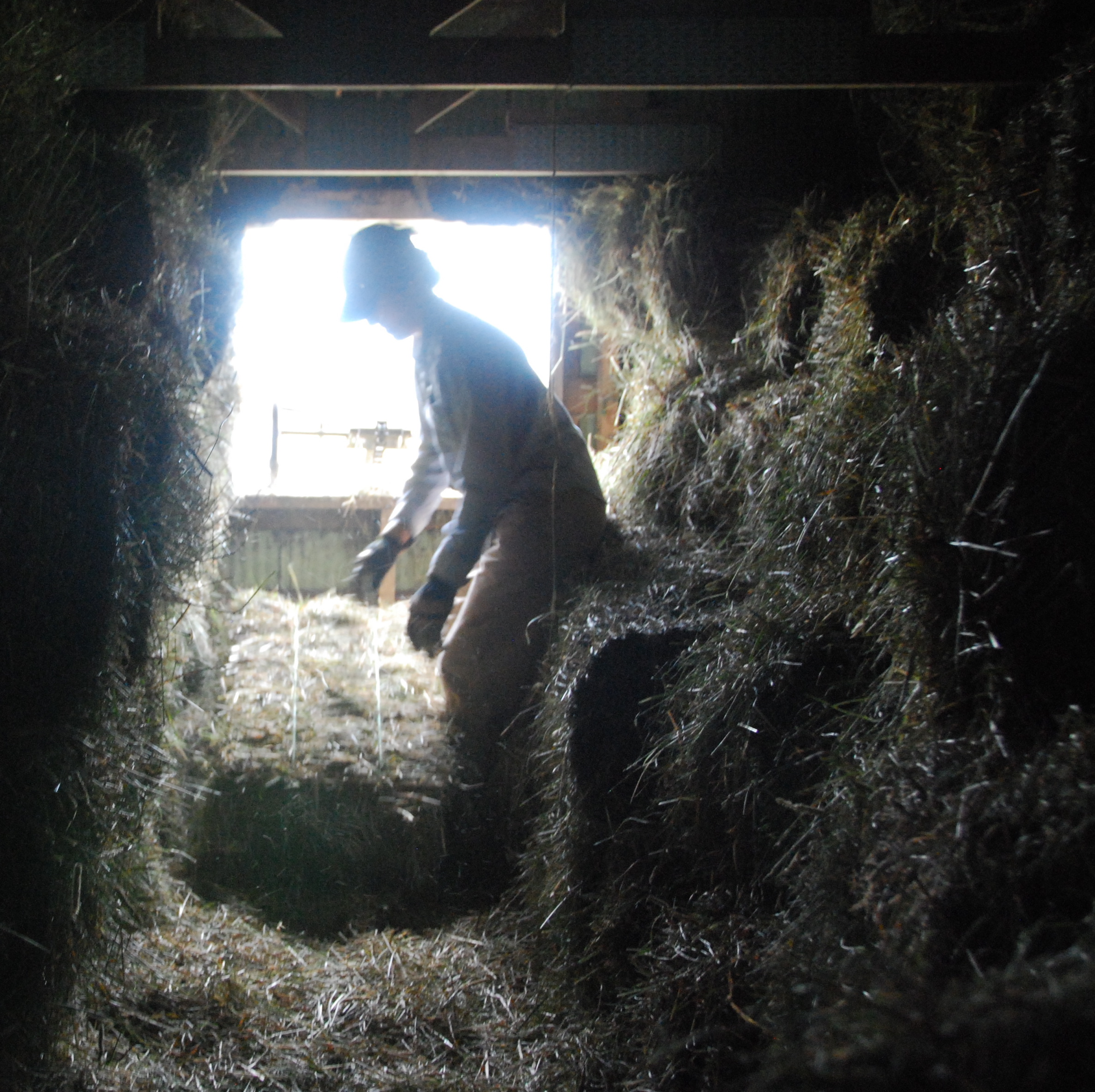
Sue, in her traditional role as the handler of small square bales. Note the trusses overhead.
It’s a tricky job for the person at the elevator. This is not an old bank barn, with its roof vaulted like a back-concession cathedral. It’s a 1980s steel barn, squat and low, with space for livestock at one end, and hay at the other. In the summer, it heats up like an oven, and there’s a truss every four feet across the roof. Once you’ve stacked eight layers of bales, you have to start ducking beneath the trusses.
Sue doesn’t always duck.When she forgets, I can hear the thump, feel the trusses shudder, and then hear muttered cuss words. “Quit hitting your head!” I shout, helpfully. This advice is never well-received. The next bale is fired at me with more force than necessary.
Outside, our two sons are pulling bales off the wagon and tossing them on the elevator, a sort of conveyor belt for square bales. After years of working for a crusty old farm employer (their dad), they now have the upper hand when it comes to putting hay in the barn. The boys’ pace sets the tempo for the sweating parents on the receiving end of their bales.
So when dad tells them to speed up, bales surge up the elevator in a grassy tsunami. When dad tells them to slow up, the crew swings towards the opposite pole. The flow ceases. Eventually a bale creeps up the elevator. After a long silence, another one drops on the elevator.
Rather than put my family through this fun every year, I’ve tried cutting back on square bales. Instead of stuffing the barn to its absolute limit, we’ve talked about ceasing the operation when the bales reach the trusses, and shifting to making round bales of hay, the kind you can store outside under tarpaulins. I’ve also tried taking Sue’s job. But when the time comes, I can’t resist trying to stuff a few more bales in the barn, even if means crawling around the trusses.
And that’s when it hits me: the same truss Sue has been softening up (without any apparent effect) for years. I curse and rub my tender noggin, and look to my wife for sympathy. She seems remarkably chipper. “Quit hitting your head!” she shouts, firing another bale my way.
They say the family that prays together, stays together. But how does the family that hays together survive the hay season? My only answer is making hay is a little like knocking your head on a rafter: it feels so good when you stop.
 Empire of grass