 Long before you see them, you hear their cries: a chorus of high-pitched, rattling “koo-roo”s, as piercing as the “whoop-whoop” of an ambulance siren at a busy intersection. For a minute or two, the cries rise into a crescendo, and then waves of Sandhill Cranes – dozens, sometimes hundreds of ebullient singers – forming ragged, noisy chevrons in the sky.
On the ground, they have the gawkiness of long-limbed teens. But aloft, they’re all grace and elegance. With their long necks outstretched and their wings spanning almost two metres, the cranes are so adept at surfing on air currents that in 2009, researcher Everett Hanna tracked one crane that covered just under 1,000 kilometres in 24 hours during a southbound migration from Manitoulin Island.
If individuals have staying power, so does the species. Based on fossil evidence, scientists reckon the Sandhill Crane has been more or less unchanged for 2.5 million years. By contrast, modern humans – Homo sapiens – have only been pausing to admire the cranes for less than a tenth of that time.
It’s easy to imagine our ancestors being captivated by the sight of dozens, maybe hundreds of cranes. They must have marveled at the size and grace of the birds, and been awestruck by the loud, migrating squadrons. They probably speculated on their culinary qualities, and mused about the best way to get such a large and wary animal out of the air, and onto a roasting spit.
For me, the rattle of the cranes is the soundtrack of spring and autumn. Halford Farm lies astride the crane’s eastern flyway, the flight path for thousands of cranes arriving from Florida each spring, and departing again in the fall. Some of these birds linger in the area, nesting in protected mounds in marshes and along shorelines. Others venture as far north as the shores of Hudson and James Bays.
On a pasture-based operation like mine, the birds forage for insects, green shoots, seeds, even rodents and snakes. I haven’t noticed that they’ve done any great harm, and I like to observe them while we’re both at work in the fields.
Grain farmers may have a different view, though. The big birds can lay waste to newly-emerging crops in the spring. In the autumn, they’ll glean the fields for grain kernels missed in the harvest. The agricultural impact has encouraged some groups to ask for a return of the crane hunt, but in some ways the bird is still recovering from the heavy commercial hunting of the 19th Century. By the time the hunt was outlawed in 1916, so few birds remained that almost all today’s eastern cranes descend from about two dozen ancestors. The result is limited genetic diversity in today’s birds.
Cranes aren’t among the most productive of birds. Most pairs mate for life, sealing their partnership with an awkward, jumping dance. They typically produce a single youngster, or “colt” per year. Years ago when my sons were young and we were waiting for their school bus, the three of us watched a flock of cranes gather to dance in the field across the road. Most birds stood in a circle around the periphery and tried to look casual, while the dancers took turns venturing onto the dance floor to flap and leap and nod. I couldn’t help but think of high school dances, only without all the polyester and Stairway to Heaven.
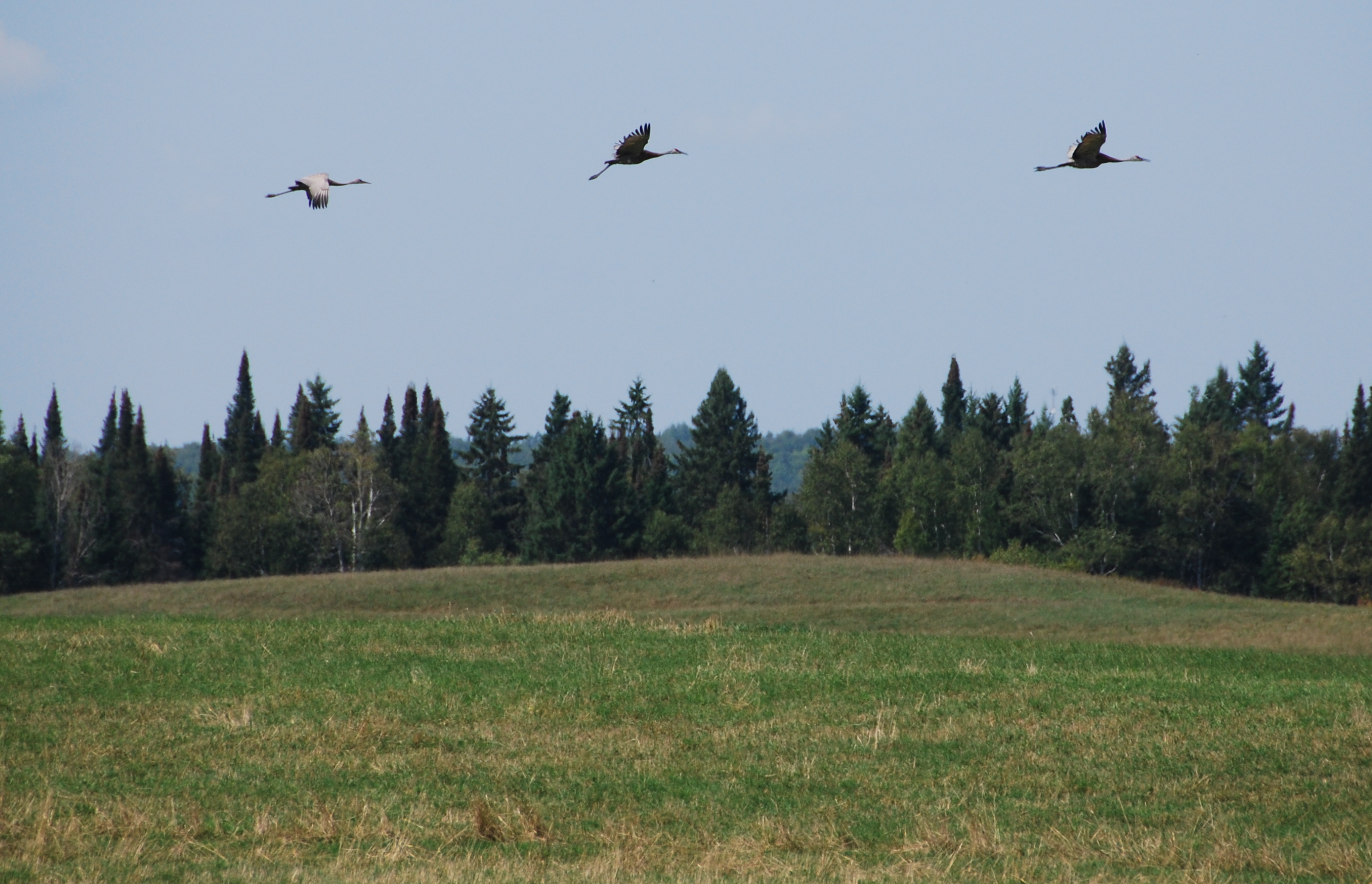
Cranes tend to travel in large tour groups of dozens, sometimes hundreds, but this past September the farm played host to a trio of birds, a nuclear family composed of two parents, and an adolescent colt. Larger flocks came and went, but for most of the month, the trio hung around our farm, becoming increasingly nonchalant as I went past on a tractor or on foot. I carried my camera out for a few days, and finally got close enough for a decent shot.
By early October, they and their compatriots were gone. On a sunny day with strong updrafts, they mount up on rising thermals, making lazy, climbing circles until they’re little more than specks in the azure sky of a sunny autumn day.
Remarkably, you can still hear their cries, long after they’ve become nearly invisible. It’s their swan song – or crane song – for the passing of another season.
 Empire of grass