
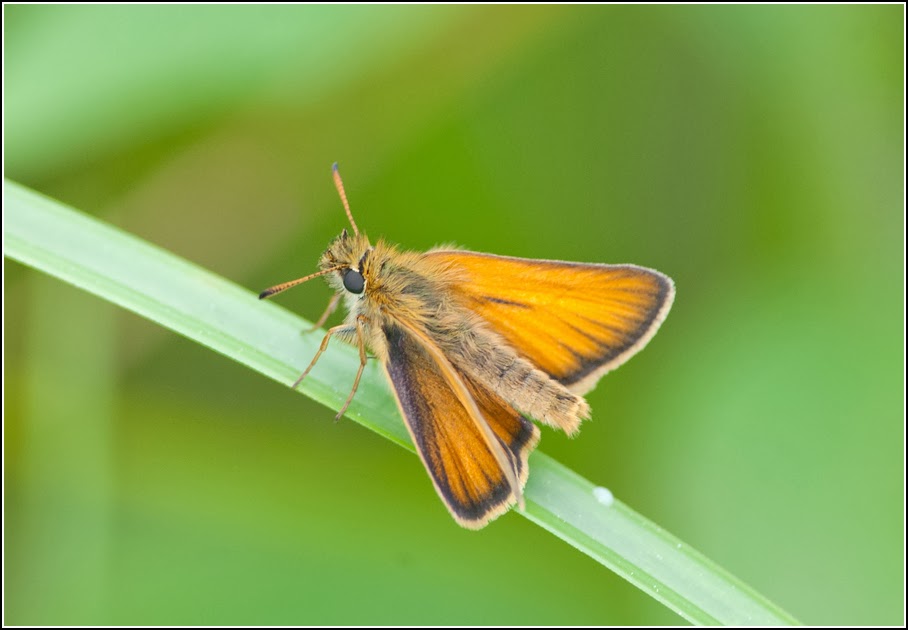
They swirl across the fields in flurries of orange and buff — tiny, delicate butterflies that skip and flutter like wind-blown autumn leaves. Beautiful though they are, these European skippers (known as the Essex skipper in the UK) are costly pests for northern Ontario hay growers.
The skipper, Thymelicus lineola is a relative newcomer to North America. Sometime early in the last century, a shipment of British glassware – packed in dried grass – arrived in London, Ont. The packing material ended up in a dump near the Dundas Street Bridge, and by July of 1910, a sharp-eyed Londoner named John Morden noticed there were new residents in the city: small, pale-green larvae were chewing their way through grass near the bridge. Later, small orange butterflies were fluttering about town.
Both worm and butterfly are stages of the European skipper, a pest with a taste for common agricultural grasses, especially timothy. By 1927, the skipper had reached Detroit. In the early ‘50s, it was defoliating pastures and hayfields in Ontario’s Grey County, some 170 kilometres from London. About a decade later, it arrived in my area of northern Ontario, a meandering 400-kilometre flight north of the Dundas Street Bridge.

1910 postcard of London’s Dundas St. Bridge. Can you see the newly arrived European skippers?
As they spread out, the insects drew the attention of farmers and motorists. Swarms of skippers “have been reported as locally annoying in many counties, with car radiators plugged and windshields smeared by driving through them,” says a Michigan State University bulletin from 1978. “The most serious infestations have been in the easternmost Upper Peninsula where estimated losses of grass hay have been up to one ton per acre “ – somewhere around a third to a quarter of the crop.
I’m on the receiving end of this voracious consumption. Most years, the larvae merely chew away some of my timothy. But in the worst case – and fortunately, I’ve only seen this once – they’ll strip the leaves off an area, leaving a forest of stems punctuated by neglected remnants of alfalfa or clover. (The skipper larvae prefer grasses to legumes.)
Fortunately, I’ve got an ally in the grass, a predator that takes advantage of the larval bounty: the bobolink. When I walk out to the pasture in June, I often see male bobolinks eyeing me from the fence wires, wriggling skipper larvae in their beaks. They’re low-cost pest control, packaged as attractive songbirds.
About the time the skipper was making its way into Canada, birds were being touted for their agricultural benefits. F.E.L (Foster) Beal was an “economic ornithologist” for the U.S. Dept. of Agriculture’s Biological Survey, helping farmers sort the “good” birds — the ones eating pests — from those targeting crops. Beal argued birds as a group are overwhelmingly beneficial. “In the course of a year birds destroy an incalculable number of insects,” he wrote in the Farmer’s Bulletin in 1915. “It is difficult to overestimate the value of their services in restraining the great tide of insect life.”
It’s an argument University of South Carolina biologist Andy Dyer picks up in his 2014 book Chasing the Red Queen. As agriculture shifts to ever more vast areas featuring just a handful of different crops, farmers have laid out an easy-access buffet for pests. Extensive fields of corn, soybeans, or cereal grains afford little habitat for insect-eating birds, for example, but offer a bounty for pests. Although chemical pesticides have helped make these crop monocultures productive, they’ve also produced a decades-long arms race, as pests evolve to resist the chemicals, and researchers are forced to devise new pesticides.
But while an insect can evolve to shrug off a pesticide, it can’t evade a bird so easily. Predators, including the bobolink, evolve along with their prey.
These days, when Trent University graduate student, Alice Pintaric, surveys insects in bobolink nesting areas, she sees a fair number of skippers. “Most of my observations of parents feeding young was with butterfly larvae specifically skippers,” she told me in an e-mail. It fits in well with a 1987 observation that bobolinks and their nestlings consume 8.65 grams of insects, per nest, per day.
To my utilitarian mind this level of “free” pest control is a strong argument for the preservation not only of grassland birds on the landscape, but of grasslands within agricultural areas. The birds sheltering on my farm aren’t just foraging on my land, but could be snapping up skipper larvae, or armyworms, or grasshoppers in neighbouring grain fields, too. In short, these birds are unacknowledged allies, complementing my efforts in the hayfield and pasture.
The challenge, then, is to find a way to make space for the bird and still be productive enough to stay in business. In a future post, I’ll talk about ways farmers are trying to share their pastures and hayfields with grassland birds, and the approaches I’ve been trying on my own farm.
-30-
 Empire of grass