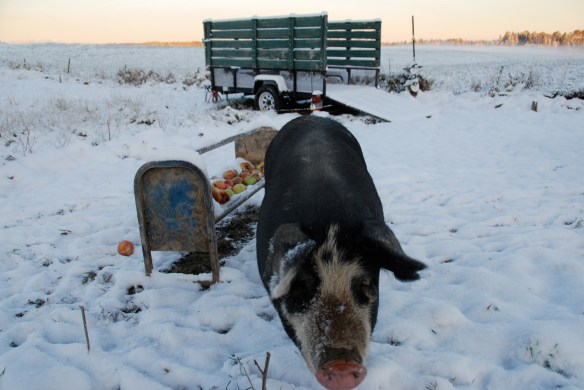
Is this little piggy ready to share?
For most of its 12,000-year history, the standard approach in agriculture has been to care for our crops and animals, while trying to exclude everything else.
Got predators? Build a fence.
Got weeds? Pull ‘em out.
Got insects or diseases threatening your crops or livestock? If you’re lucky, you can find the solution in a spray tank, or a medicine bottle.
The result is modern monoculture: individual crops dominate fields, and a handful of domesticated plants sprawl over vast areas. Visit farm country, and you’re apt to see rank after rank of corn, or soybeans, or cereal grains striding across countless acres, with as little competition as possible. It’s an efficient way to produce commodities. And after all, when you’re a farmer, no one’s paying you to grow weeds or harbour wildlife.
At the same time, monocultures are hard on the natural environment. Landscapes covered by a single crop are necessarily uninviting for other creatures – except for the pests that eat that crop. As the human population expands, the conventional approach to agriculture risks turning earth into a planet of croplands, while the rest of creation is shoehorned into the margins. (As I write this, the World Wildlife Fund has released a report saying this process is already well underway, with populations of mammals, birds, fish, amphibians and reptiles falling by almost 60 per cent since 1970.) Continue reading
 Empire of grass