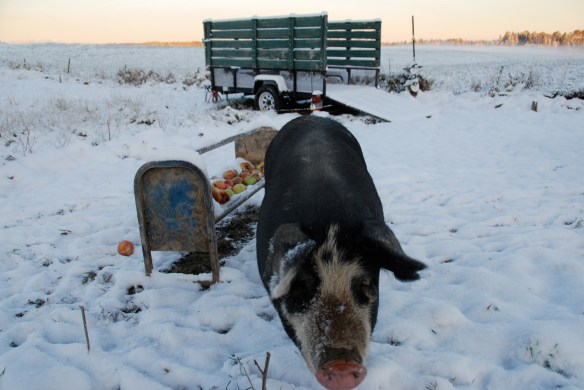
Is this little piggy ready to share?
For most of its 12,000-year history, the standard approach in agriculture has been to care for our crops and animals, while trying to exclude everything else.
Got predators? Build a fence.
Got weeds? Pull ‘em out.
Got insects or diseases threatening your crops or livestock? If you’re lucky, you can find the solution in a spray tank, or a medicine bottle.
The result is modern monoculture: individual crops dominate fields, and a handful of domesticated plants sprawl over vast areas. Visit farm country, and you’re apt to see rank after rank of corn, or soybeans, or cereal grains striding across countless acres, with as little competition as possible. It’s an efficient way to produce commodities. And after all, when you’re a farmer, no one’s paying you to grow weeds or harbour wildlife.
At the same time, monocultures are hard on the natural environment. Landscapes covered by a single crop are necessarily uninviting for other creatures – except for the pests that eat that crop. As the human population expands, the conventional approach to agriculture risks turning earth into a planet of croplands, while the rest of creation is shoehorned into the margins. (As I write this, the World Wildlife Fund has released a report saying this process is already well underway, with populations of mammals, birds, fish, amphibians and reptiles falling by almost 60 per cent since 1970.)
As British researchers Andrew Balmford, Rhys Green, and Ben Phalan wrote in a 2012 article, agriculture “is the basis of our civilization, yet it is more damaging to wild nature than any other sector of human activity.”
But since we need food, how do we produce enough of it in the least damaging way? The Balmford article outlines a few approaches, including “land sharing,” – making agricultural land more hospitable to wildlife, and “land sparing,” using some areas intensively, so other areas can be left wild and untouched.
I’ll leave the merits of land sparing for others to debate, since that approach largely applies to crop production. But grassland farmers are well positioned to be land sharers. By managing pastures, hayfields and ranges to mimic natural grasslands, we can create more space for a wider range of insects, birds, and animals. Equally important (but seldom recognized) is the diversity of life in grassland soils, including the microbes, fungi, and associated critters crucial to plant growth.
But land sharing is full of challenges and tradeoffs. It’s by no means a happy Disney-themed world where farmers and wildlife join hands and sing – just try sharing your sheep pasture with the local pack of wolves or coyotes.
The challenge for farmers is to find a ways to make room for nature, without unduly damaging the economic viability of the family business.
This past spring ON Nature Magazine assigned me to poke around the countryside, talking to farmers who are trying to feed their stock and still maintain grassland bird habitat. This is no mean feat, as the birds’ nesting season coincides with the peak nutritional value of the grass they’re nesting in. For farmers, the challenge is taking advantage of that highly nutritious grass, while still leaving room for swallows, bobolinks, and meadowlarks. In my next post, I’ll outline the innovative strategies these farmers are trying.
-30-
 Empire of grass