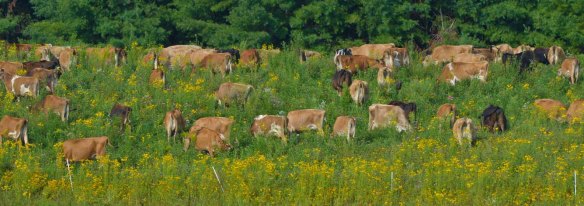
Bill Van Nes’ Jersey cattle dairy cattle grazing a tallgrass prairie mixture in western Ontario. Photo courtesy Bill van Nes.
An old Guess Who song – delivered in Burton Cummings’ rock-crooner voice – is rolling through my head:
Maybe I’ll be there to shake your hand (Shake your hand)
Maybe I’ll be there to share the land (Share the land)
That they’ll be givin’ away
When we all live together…
For those unfamiliar with the Winnipeg band, the Guess Who cranked out at least a dozen hits in the ‘60s and ‘70s– tunes that still fill airwaves on Classic Rock FM stations in Canada. Burton Cummings, Randy Bachman and the boys grew up on land that was probably once tallgrass prairie. By the time they were a garage band in the early ‘60s, most native grassland had been ploughed up and transformed into grain fields. (Not surprisingly, the band has an album called “Wheatfield Soul.”)
Now the Guess Who are helping me pull together a couple of approaches to land management. The last post outlined two ways to farm and conserve the natural world: “land sparing,” converting some areas into highly-productive crop fields in order to spare remaining natural areas; and “land sharing,” creating a countryside with room for both humans and wildlife.
The Guess Who grew up in a variation of the land-sparing landscape, with lots of crop fields and a some nature. But in 1970 they released the tune now stuck in my brain, Share the Land. It’s heavy on the peace-and-love 1970 vibe, but the essential idea is a place where “we all live together.” Earlier this year, in a story that won a gold award from the federation of Canadian agricultural journalists, I profiled farmers seeking ways to share their land with wild and domesticated species – in this case, cattle and grassland birds. It’s a big challenge. Birds and livestock compete for the same fields at the same time. Bobolinks, meadowlarks, and sparrows seek grassy fields to nest and raise their young from May to early July. Meanwhile, farmers are eyeing those same fields as sources of hay and pasture.
When birds meet hay mowers or cattle, the birds usually lose. Ontario’s bobolink numbers have fallen by more than 77 percent since 1970, partly because there are fewer grassy fields on the landscape, but also because farmers are using remaining grasslands more intensively.
The good news, as I wrote for ON Nature magazine, is there are farmers looking for solutions. Their ideas include:
1) Putting more grass on the landscape.
Grassland birds are “obligate” grassland users, meaning they need grassy fields with the right mix of plants and some thatch (dried, dead grass) for prime nesting areas. Cornfields don’t work. So promoting grassland agriculture (as opposed to crops like corn, soy, or wheat) is one way to boost bird habitat.
Dairy farmer Bill van Nes farms 1,200 acres near Brussels, Ont., with about two-thirds of that area in grass rather than crops. He’s also sown native tallgrass species in some of his fields, and is experimenting with it as pasture. “I’m converting more acres to grassland, and just doing that is beneficial to the birds,” he says.
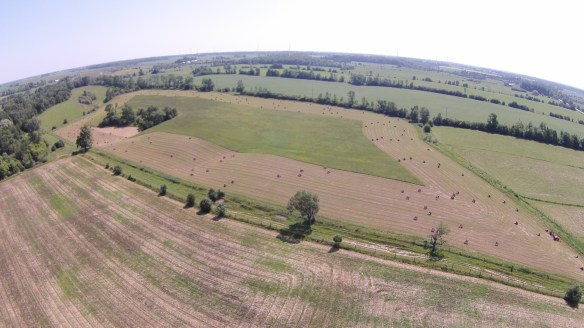
Tom Franklin’s “wildlife island,” surrounded by hay bales. Photo courtesy Tom Franklin.
2) Grazing when the birds aren’t there.
One option is to graze before mid-May and then after mid-July, leaving the area untouched during the prime nesting period. It’s difficult in many cool-climate areas of Canada because grass tends not to get going until mid-May, and is overly mature and unpalatable if left ungrazed until mid-July. Nonetheless, a few farmers are working around these problems. In Renfrew County, Craig McLaughlin “stockpiles” autumn grass, letting it grow long and ungrazed, and then turns cattle onto the stockpiled forage in April. Once the previous year’s growth is grazed off, he moves the cattle, allowing the pasture to recover.
“It’s strictly economics,” he says. “The less feed I put up and the more grazing days I have, the better off I am. There are repercussions to that, and one of them is it benefits the birds.”
3) Mowing around prime nesting zones.
The most novel land-sharing effort I’ve come across was launched by cattle farmer and high-school science teacher Tom Franklin. He rigged up a drone with an infrared camera, and flew it over hayfields to survey bobolink and meadowlark nests. While the off-the-shelf technology wasn’t sophisticated enough to detect the heat from nesting birds, “I discovered that if you stand in a field long enough, you find out where the birds are anyway.” He learned birds prefer the centre of his fields, shying away from edges, woodlands, and perches for predators.
By mowing the first 50 metres or so around the perimeter of his field and leaving the rest, Franklin maintained the prime nesting area as a “wildlife island.” Once the birds clear out in July, Franklin harvests the rest of his hay. He reckons this system allows him to harvest most of his hay at its peak nutritional value, while still leaving room for the birds.
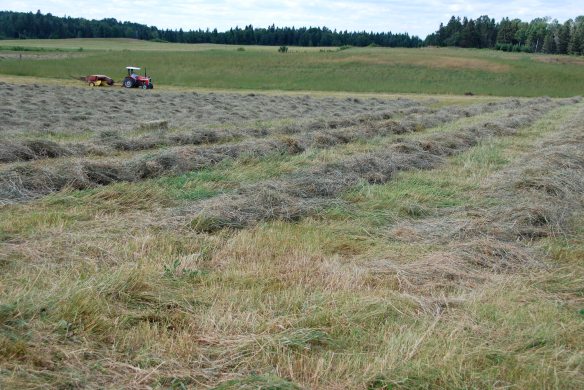
A “songbird strip” about to be baled after nesting birds have migrated in mid-July.
4) The “songbird strip.”
Quite independently, I ended up with my own variation on Franklin’s approach. I run my fields like a chessboard, moving the sheep and cattle across the field to a new half-acre or acre square every day. It’s a great for soil and grass productivity, and animal health, but I suspect it disrupts nesting for songbirds. Now I look for nesting zones, watching for male birds flying back and forth carrying insects to feed nestlings. If I can, I divert the livestock around these “songbird strips,” – in effect, leaving some ungrazed squares in the middle of the chess board to be harvested later as hay.
There are other approaches, too. There are fields the birds don’t like – the ones that are too small, too close to traffic, with too many predators, or with the wrong mix of plant species. So why not mow those first, and leave the prime areas until later in the season? It requires a little planning, but saves nesting habitat at little or no cost to the farmer.
Farmers are natural problem solvers. Many are already land sharers, without recognizing it. As Tom Franklin told me, he’s not much of a birder, but he likes to farm with the environment in mind. Saving grassland birds “is the opportunity that has fallen in my lap. I would think anybody in my situation would do pretty much the same thing.”
So there’s hope for folks who want to share the land. In some cases, maybe we really can all live together.
Speaking of the Guess Who, I’m off to Winnipeg next week for the annual meeting of the Canadian Forage and Grassland Association. I’ll be taking the train there and back (four nights, two days on the rails, if all goes well). I’ll share some of the experience in future posts.
-30-
 Empire of grass