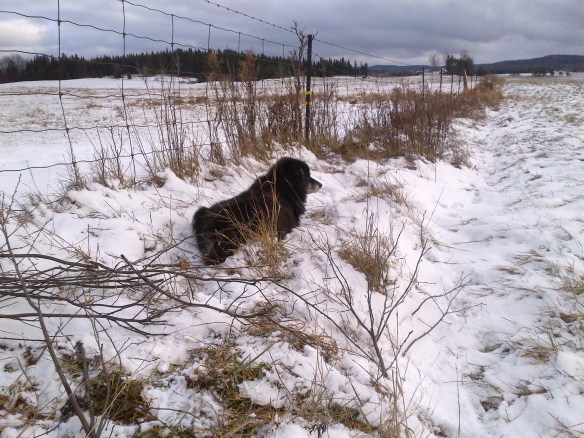
My “helper,” assisting with fence maintenance.
I was brushing out a fence line a few days ago, hoping to make gains before the snow comes. But as the wind drove the snow down the back of my collar, my thoughts were in a much warmer place – with Allan Lemayian and his insurgent cattle in Nairobi, Kenya.
Mr. Lemayian is a pastoral Robin Hood, profiled in a recent New York Times story. As development paves over the grasslands his ancestors once relied on, the lanky Maasai man has brought his herd into the suburbs, snatching grass from cemeteries, roadsides, even the lawns of the well-off.
I found myself admiring Mr. Lemayian’s gumption, rooting for him as his herd dodged traffic and he endured the taunts of BMW drivers. “Take your animals back to Maasailand,” one shouts. “You look like your cows,” says another well-heeled motorist.
Mr. Lemayian’s guerilla grazing may seem like an exotic tale from a distant country, but his predicament is one we all share in. Archaeologists have long suspected East Africa’s extensive grassland savannahs are the cradle of humanity. Now, not just in Africa but around the globe, we’re ploughing under or carving up the landscape that nurtured and still feeds our species, with dire implications for the planet’s climate and the creatures that share the grasslands.
Maybe we’re all more like the impatient BMW drivers, oblivious to the changes we’re causing, contemptuous of the rural people who are among the most obvious victims, and unaware of the connections between our dinner plates and disappearing landscapes.
-30-
 Empire of grass