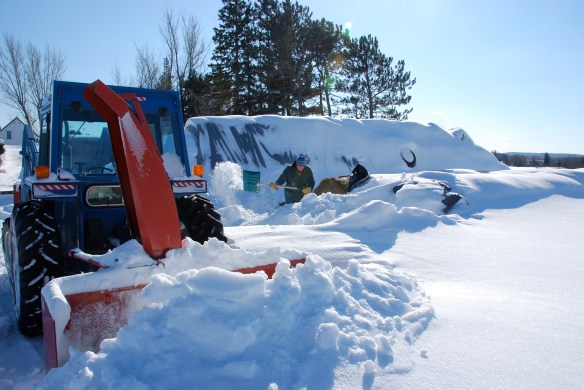
Excavating a round bale, Feb. 16 2017
Now is the winter of – not our discontent exactly – but of our calculating. And concern.
We started the winter with about 230 round bales of hay, and now, with each passing day, another round bale disappears into the mouths of our sheep and cattle. While each day brings us closer to spring and the onset of grazing (typically around the 24th of May, give or take a week), we’re also slowly exhausting our winter hay supply. And we absolutely cannot, for reasons of animal welfare and farm finance, run out of hay before the pasture is ready.
The reason is simple. Without hay, ewes and cows go hungry at the same time as they’re feeding new lambs and calves. It would be a disaster. At the same time, laying in extra hay would be almost prohibitively expensive, if it was even possible.
So I keep a running inventory in my head. As I write, I’ve got about 88 bales. If all goes well, that’s enough to get me through to late May. I cross my fingers and hope for a “normal” spring.
Hay is very much a product of moisture. In a wet year, grass grows, and everyone has lots of it. (Although hay quality is often poor in rainy summers, but that’s another story.) In a drought, like the one that affected a large swath of Ontario in 2016, scant yields lead to tight supplies and high prices. In our case yields were down about 30 percent below normal.
While weather is the immediate cause of the shortage, there are other factors behind the trend. An astounding 17 per cent of Ontario’s agricultural grasslands disappeared in just five years, between 2006 and 2011. In part, this is because higher grain prices pushed farmers to shift their land to crops. At the same time, cattle numbers were trending down, as the industry struggled with low prices following the outbreak of Mad Cow Disease in Canada, earlier in the decade.
The remaining hay ground is also less productive. Across Canada, hay yields, measured in tons per acre, are 14 percent below the levels of the 1980s. With the increasing value of grain crops, “we’ve pushed our forages onto marginal lands that don’t have the capacity to produce those yields anymore,” Calgary-based researcher Brenna Grant told me.
So this year, the price for hay is soaring. “In 2015 in our area, hay was $45 a round bale. This year it’s $110,” central Ontario cattleman Ron Lipsett said at a meeting in Mount Forest, Ont. last week. It’s a seller’s market, and I’m hoping to squeak through the winter without becoming a buyer.
For urban readers, fretting over something as common as dried grass may seem odd. But hay is such an essential fodder for ruminants that I struggle to find an analogous food in the human diet, at least for modern westerners. In previous eras, going without hay would be akin to rationing bread, or porridge, or potatoes. But it’s more than that. For ruminants, hay is almost a complete meal. It provides proteins, sugars and carbohydrates, fibre, and some vitamins and minerals to boot. In other words, hay is a cow’s equivalent of meat and two veg, with a salad on the side. Partial substitutes are available: straw, or extra grain, or even “cull” vegetables considered unfit for human consumption. But those can be expensive stopgaps.
So I count the bales. And I can’t help remembering the old bus-trip song. Remember the one about bottles of beer on the wall? I’ve got new lyrics:
Eighty-eight bales of hay on the stack, 88 bales of hay.
Take one down, pass it around. Eighty-seven bales of hay…
You get the idea. I’m hoping spring comes soon. I need to get this tune out of my head.
 Empire of grass