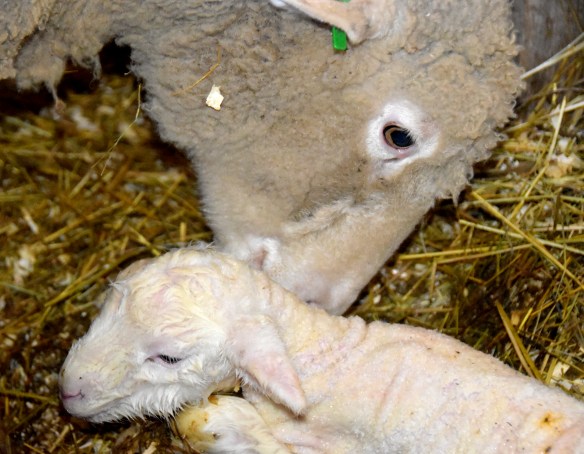
A ewe licks her lamb minutes after his birth. (I’ve just towelled off the lamb’s head to clear the amniotic fluid from his nostrils.) The ewe’s licking seems to play a major role in the maternal bond, helping ensure she claims the newborn as her own.
One of the very first memories I have of farm life – along with having my finger bitten by a duck and feeding milk to kittens – is staring goggle-eyed at a wobbly newborn calf, and the vast pool of gelatinous, red placenta that had just slid from its mother.
I was three, I think, and both fascinated and repelled by the afterbirth. This inert, cast-off sack and the calf went together, in a mysterious way I could not fathom. The gooey organ seemed dead, yet it was intimately connected to this new life.
I think about that now during lambing season, when our business involves the safe delivery of creatures previously hidden in the liquid embrace of their mothers’ wombs. Living on a livestock farm is, literally and figuratively, a visceral experience – one involving both internal organs, and gut-level emotions. But it’s also revelatory, as the strains of labour and delivery reveal not only new calves and lambs, but the maternal abilities of their mothers, and our own skills as farmers and livestock obstetricians.
Despite our best efforts, there are times when the consequences are tragic: complicated labours, stillborn or dying animals, and tired, heartbroken shepherds. In other words, this one neglected and underpaid job encompasses the entire realm of experience, from birth to death, with much blood, sadness, and joy in between.
I pass lightly over these issues when writing for a non-farm audience, but I’ve been rethinking this approach after reading James Rebanks’ The Shepherd’s Life. Rebanks is a hill shepherd in England’s Lake District. He became a media sensation after he bought a new smart phone and started posting photos and comments on Twitter.
One of the remarkable things about Rebanks’ book is he takes great pains to portray the full range of farming life, from sunny-day highs to vet-call lows. And his childhood memories aren’t that different than mine:
“Blood was everywhere when I was a child. Sheep lambing, bloody hands, dehorned cattle…Cow Caesarians, men with armfuls of guts and blood, and then shoving it all back in and stitching it up,” he writes, perhaps a bit gleefully. “We accept blood as normal as long as it stops flowing, and the skin scabs over and it heals.”
Ditto for manure and mucus (or, as Rebanks puts it, “shit and snot.”) This is a job deeply immersed in the stuff of life. “You learn to accept that you will get spattered in shit at times, or slaver, or afterbirth, or snot. That you will smell of your animals,” Rebanks says. “You can always tell how alien someone is to our world by how terrified of the muck they look.”
So I was surprised, recently, to read an anecdote about Charles Darwin. A shrewd observer and subtle thinker, Darwin nevertheless seems to have started with a sort of Sunday School, All-Things-Bright-and-Beautiful view of creation – the kind that’s hard to maintain on a farm.
After discovering a parasitic wasp that laid its eggs within a caterpillar, Darwin’s faith was shaken. “There seems to me too much misery in the world,” he wrote. “I cannot persuade myself that a beneficent and omnipotent God would have designedly created the [parasitic wasp] with the express intention of their feeding within the living bodies of caterpillars.”
There is misery in the world. But you don’t have to spend long on a farm to know the agenda of other creatures doesn’t fit neatly with your own goals. While Darwin was repelled by the parasite, I can’t help seeing a planet that is jam-packed full of life – even the lives we don’t favour. As far as we know – and this may change one day – we live on the only place in our universe that houses life. And it doesn’t just do so in a grudging way. This planet is full of living things, in every niche, and on every surface, and at every depth and height.
It all fits together, blood and mucus and manure and amniotic fluid, birth and death and sunshine and rain, to create this difficult, astounding, life-filled experience. Farmers are immersed in this experience, and that makes us an increasingly rare group, in a society that works hard to remove the viscera from daily life, and transfer it onto screens in the guise of violent “entertainment.”
True, there are days when I emerge from the barn feeling beaten down, tired, or dispirited. But on the whole I’m grateful to participate and observe a world that’s still visceral.
-30-
 Empire of grass