
Thanks to T.S. Eliot, I know April is the cruelest month. So why was I surprised when this past April capped an unusually mild, wet winter, with a cool, unusually wet spring?
The nadir came when a storm brought heavy, driving rain, then freezing rain, then ice pellets, and finally, snow on the weekend when March turned into April. While lambs and ewes huddled in the barn, the cows were exposed in their wintering yard – a sandy, gravelly area that’s usually dry underfoot.
Traditionally, winters in our area are cold enough that cattle winter in a sheltered area outside, on “country concrete” – frozen ground. But this year’s thaws and moisture regularly transformed our country concrete into the pockmarked slurry of a First World War battlefield. The mud got so thick – and our four-wheel-drive tractor was doing so much damage – that for about a week or so we left the tractor in the shed and hand-lugged square bales to the feeder.
But as the storm turned even dry areas into mush and some of the cows weeks away from calving, we had to find dryer ground. With the help of my son, Cam, we evicted the ewes and lambs from the dry corner in the barnyard and shut the flock into the barn. Slopping around in the muck in rubber boots, with wet snow sliding down the backs of our collars, we dragged the cattle feeder area onto dry ground near the shelter of the barn wall. We dropped a bale into the feeder, invited the cattle in, and hoped for the best.
After an hour of this we were sodden, cold, tired, and exhilarated to be out fighting the elements. “It’s days like this that make this job so much fun,” I said. Cam grinned. We both share the farmer’s perverse enjoyment of hard work in bad weather. Then we ducked into the shelter of the barn, and felt the warmth of the flock and its newborn lambs.
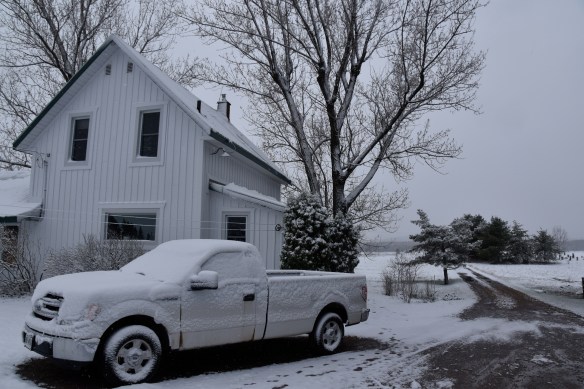
Welcome to spring!
Thanks to climate change, what constitutes “normal” weather has become a moving target. For those of us fortunate to have seen 50 years in the same area, what’s “normal” is necessarily backward-looking – rooted in the snowy winter sledding days of our youth, or hazy summer days with high-school friends at the beach.
Those memories are faulty, and not just because of the usual tricks our brain plays on us. Our recollections of “normal” summers and winters are drawn from a different climatic era, from a life lived within a different atmosphere. When I was born in 1964 the air above me had about 319.5 parts per million of carbon dioxide. This past April, the Mauna Loa Observatory in Hawaii tracked a new record high for carbon dioxide: 410.28 ppm.
It’s a strange thing to get your head around – that the sky above you now is not the same one you were born beneath, and it’s making the climate behave differently. With this pace of change, how many of my assumptions – like wintering cattle on country concrete – need to be rethought?
While we struggled with mud on the farm, lakes and rivers were swelling across much of eastern Canada. By late April and early May, homes and cottages along the Ottawa River, parts of east-central Ontario, Lake Ontario’s shore, and regions in Quebec and New Brunswick were hit by severe flooding. Areas including Renfrew and Haliburton counties received twice their normal precipitation in April and May. Many residents said they’d never seen the water so high.
“I don’t expect this is ever going to happen again,” one man told me, when I was working on a story about the flooding for Cottage Life Magazine. “This was the 100-year flood.”
I hope he’s right, and I hope I never see a winter and spring this mucky, too. But some high-powered science sponsored by the Muskoka Watershed Council suggests we both need a Plan B. Using sophisticated computer models, the Council projected the ways the region’s climate could differ by 2050. The bad news is this past winter looks almost like a trial run for the future. By 2050, on average, there will be more precipitation, with most of the additional rain and snow – 17 per cent more than today – falling from November through to April. More remarkably, winter lake and river outflows will be three times higher than they are today.
If that’s true, country concrete will be a less reliable commodity. Struggling with a feeder in the mud won’t be an exhilarating challenge, but a regular slog. I’m hoping for a return to colder, crisper winters. But in the meantime, I need to work on Plan B.
-30-
 Empire of grass