Earlier this month, I was mucking out a stall and listening to a radio interview with American writer Ta-Nehisi Coates, when I heard him say a striking thing. Mr. Coates writes a lot about racial issues, and the interviewer asked “what gives you the most hope for the future?”
“It’s a hard question for me to answer,” he said, framing a long and nuanced response that’s worth listening to in its entirety. “Writers and journalists are generally not in the business of giving hope.” If his reporting doesn’t make readers feel optimistic, “you should see your pastor. That’s not my job.”
Pretty blunt stuff, I thought, as I tossed another forkful into the manure spreader. When most radio guests would reach for an upbeat ending, Mr. Coates obviously doesn’t believe in sugar coating things. More power to him.
But I think writing, like farming, is a hopeful act. Even Mr. Coates must hope his stories promote better understanding and plant the seeds of change. In a like way, pasture-based farms are a commitment to the future. We work with perennial plants – species that grow year after year – not just to feed people and livestock, but to sustain a productive earth. In the process, we hope for financial rewards, but we also reap unexpected benefits.
Sometimes these are aesthetic payoffs, like the beauty of a sunrise, or a lush stand of grass that dips and bows in the wind. One of 2017’s eye-pleasing bonuses came from an effort to get rid of an invasive weed called smooth bedstraw (Gallium molugo.) To clear the weed from an infested area, I had a friend plough the ground last fall, and then I sowed an annual mixture of Italian ryegrass and crimson clover (Trifolium incarnatum) this spring.
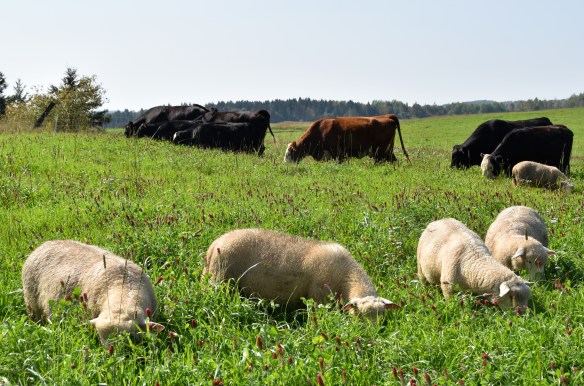
The goal is to produce a lush crop of clover and ryegrass that will help smother the bedstraw, reduce the number of surviving weed seeds in the soil, and provide good grazing. Next year the area will be replanted with a perennial hay and pasture mixture, and my bedstraw problems will be – fingers crossed – sharply reduced.
These varieties of ryegrass and the clover are more common in Europe and parts of the U.S., where they’re hardy enough to survive the milder winters. In most regions of Canada, winter kills off the clover and ryegrass, but they’ve still become increasingly popular as annual crops among livestock farmers. The ryegrass is prized for its high sugar content when grazed or made into hay or silage. Crimson clover – a species that was completely new to me – is a soil-building legume that boosts fertility and improves soil texture.
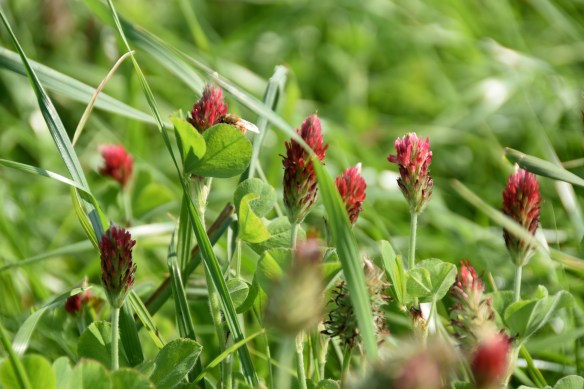
At least, that’s the plan, and despite a wet spring and late start, it seems to be working. But here’s the real bonus: the crimson clover turned out to be gorgeous – so pretty, I could almost plant it as an ornamental. When you’ve been in and around farms for most of your 50-odd years, it’s oddly exciting to grow something so new and striking.
My enthusiasm might not be surprising to a rose gardener, but as someone who never did much flower gardening (that’s my wife’s job) I was quite taken with this showy new clover. Aesthetically, at least, it was the highlight of our forage season.
By nature, most farmers are primed to cope with unexpected misfortunes, because those are going to happen. But I’ll argue it’s equally important to be open to surprising moments of wonder and beauty, and to reap those rewards when they come.
If that’s farming in hope, I plead guilty as charged. The way I see it, hope really is part of my job.
-30-

 Empire of grass