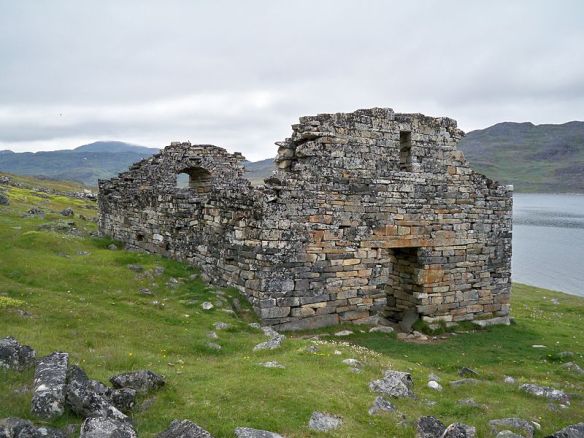
The ruins of Hvalsey Church, from Greenland’s mediaeval Norse settlement.
Ah, the placid greenery of gentle lawns and pastoral vistas. But grass didn’t get where it is today – that is, nearly everywhere — by being gentle and placid. Instead, Swiss botanist Hans Peter Linder argues grasses are the plant world’s Vikings – fearsome raiders who, as Linder and his co-authors write in a recent article in the Cambridge Philosophical Society’s Biological Reviews, are leafy “invaders from hell, bringing fire and hungry herbivores in their baggage.”
If your main contact with grass is limited to walking on it, you could be forgiven for underestimating the prickliness of the floral family variously known as Poacae or Graminae. Linder and co-authors Caroline Lehmann (like Linder, a faculty member with the University of Zurich), Sally Archibald (University of the Witwatersrand), Colin Osborne (University of Sheffield), and David Richardson (Stellenbosch University) argue grasses are among the planet’s floral overlords. Grass-dominated ecosystems cover up to 43 per cent of the earth’s land surface, and grass species are found on every continent, including the Antarctic. Grass is nearly ubiquitous wherever humans live, play, and farm.
It wasn’t always this way. Perhaps 80 million years ago, the ancestors of today’s grasses were bit players, “relatively unimportant forest-understory plants,” according to Linder. So how did this meek floral sideshow become one of the terrestrial environment’s main players? It succeeded with the help of what Linder calls “the Viking syndrome.”
Like the shipborne raiders of yore, grass was good at dispersing. It hitched a ride on – or in — animals and birds, was blown aloft on winds and perhaps even rafted across seas on flotsam. When those seeds landed in the right place, they could germinate quickly, and then fortify their position by producing more seed, or expanding through rhizomes. As a plant that tended to reproduce annually, but maintain the staying power of a perennial, grass could spread more rapidly than the trees that dominated the ancient landscape. Rapid generational change exploited the plant’s “phenotypic plasticity” – its ability to make genetic changes to cope with new conditions.
When a tree fell in the forest, grass was ready to step into the sunlight, and thrive. It spread along forest edges, and as dry spells weakened the forests, grasses seized more open ground. Whenever climate change or disaster thinned, toppled, burned or froze the vast treed canopies that covered the globe, grasses proved nimble opportunists. Over the past 25 million years or so (with the greatest strides coming only in the most recent millions of years) grasses won vast regions of the globe. They ruled over extensive ecosystems, dominating zones where precipitation is too meagre to support forests.
This expansion has been supported by a range of allies, including fire, grazing animals, underground fungal networks, and in the latest chapter, humans. As Linder points outs, grasses haven’t merely usurped resources from other species, they’ve literally transformed the landscape to the disadvantage of competitors.
Most grasses tolerate, and even encourage fire with their annual output of dead, papery leaves. When a fire sweeps through the sward, incinerating trees, seedlings, and forbs with overhead temperatures rising up to 700 degrees C, the sensitive growing buds of grass plants ride out the conflagration, nestled near the cooler, moister soil surface. Meanwhile seeds, shielded by a layer of insulating soil, emerge to take advantage of the ground the fire has cleared and fertilized with its ashes.
Extensive grasslands act as seasonal buffets for vast herds of grazing animals, and these creatures trample, eat, or scratch themselves on growing trees (helping to kill off the competition) while eating the grass. Being eaten usually means death for many other plants, but thanks to their low-level buds, grasses survive and even thrive under episodes of grazing. They have, as Linder says, “a biology enabling survival in the face of constant defoliation.”
Finally, there’s the bipedal animal – us humans. We’ve also spread grasses wherever we go, as lawns, playing fields, crops and pastures. Over thousands of years we’ve worked with fire and the axe to push back the trees. We’ve encouraged the growth of grass to draw the sort of wild animals we preferred to hunt, and later, we domesticated grazing animals. Now, ironically, humans are the major threat to natural grasslands (and in some cases, even agricultural grasslands). But that comes much later in the story.
Even so, we still live in an empire of grass, a domain far more extensive and longer-lasting than the Norse realm Linder compares it to. I like the way Linder’s paper confers a certain agency, even swagger to this crucial family of plants. If we think much about plants at all, most of us see them as part of the scenery, passive recipients of whatever the weather and us animals dish out.
But if grasses are acting, as well as being acted upon, they’re also more than floral Vikings. One of the striking parts of the grass story is the way this once-minor plant has enlisted allies and enmeshed itself into the lives of so many other creatures. And while grasses have been, as Linder suggests, invasive and aggressive, the survival strategies of both grasses and grasslands include resilience, diversity, co-operation and even humility. I’ll be exploring these and other issues in future posts.
Grass has reworked the way the planet looks and operates. It has altered the flows of water, nitrogen, and carbon in and over the Earth’s surface. And it has facilitated the rise of human civilization.
“By all measures,” Linder says, “grasses have a significant and arguably disproportionate impact on global ecology…and human subsistence.” Compared to the impact of this green emperor, the Vikings were bit players.
-30-
 Empire of grass