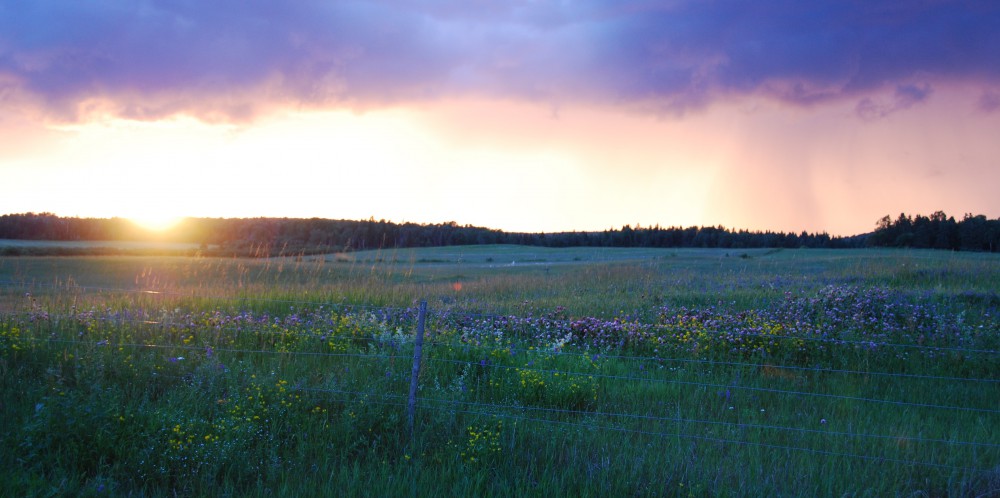
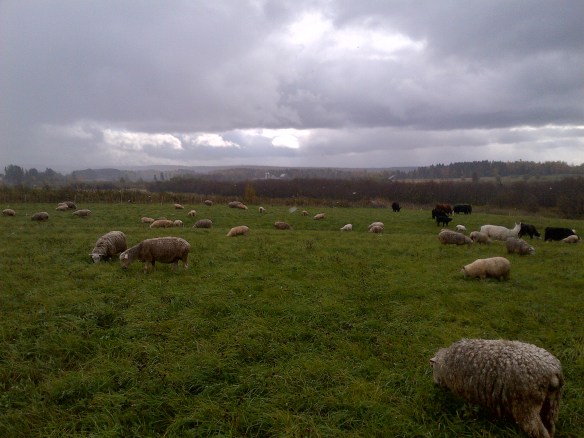
October 17: Lots of lush autumn grazing is still available, but an early-season snow flurry hints at the winter to come. (And the hints were well founded: We’ve had snow on the ground since Oct. 30.)
It’s a decent walk to the back of the farm – about 2,200 feet, or just under half a mile. I like it. It’s good exercise, and I think my brain works best at a walking pace.
In October, with the sheep and cattle grazing hard by the farm’s rear boundary, the trek became my daily constitutional. There was almost always electric fencing to move, or water to check on. In dry weather I could make the journey by tractor, but autumn’s heavy rains left the ground soft and muddy, so I substituted boot leather for diesel.
Somewhere around the half-way point, white-tailed deer forage on the far edge of a field — so comfortable with my regular commuting that they just stand and watch. Along the fencelines, flurries of fat little white-crowned sparrows rise from the grass. One day there were five or six eastern bluebirds along the backfield fence, the bright autumn sun turning their backs an electric blue. The day before, soft white snowflakes fell from a gunmetal sky.
About 10,000 years ago this country was sculpted by glacial meltwaters. Back then, a vast, turbulent river flowed east from the ancestor of Lake Huron towards the precursors of the Ottawa and St. Lawrence Rivers. The waters piled up sandbars that are now hills, depositing thick knolls of gravel and laying down dense layers of clay.
Now it takes a bit of imagination to see this an ancient glacial channel. Long-departed waters have scoured the land smooth, leaving a rounded landscape of grassed-over mounds and folds. About a century and a half ago, surveyors laid the groundwork for another transformation, parcelling a long-settled indigenous landscape (although one that must have looked like “untracked wilderness” to Europeans) into tidy 100-acre lots, each three-eights of a mile wide, five-twelfths of a mile long.
That survey line has wrought long-lasting change, displacing a people and laying the groundwork for forest to become field. For good or ill, I now walk within the boundaries of that survey, and I’m reminded how my relationship to land is an intimate one. This is, I hope, a lifelong partnership between farmer and land, even if the farmer is always fated to be the junior half of that partnership.
The land seems eternal, but it’s not unchanging. Even for us junior partners, it’s easy to make a misstep. To opt for tilling when the soil needs rest, for example, or to farm in a way that extracts fertility, rather than regenerates the health of the soil and the broader landscape. Making a gash in the earth seems quick and easy; but the work of soil building, of stewardship is incremental and difficult. To complicate factors, sometimes what turns out to be a misstep seems like the right choice at the time, when money is tight, or you really need that extra cut of hay for winter. In my life as a farmer, no less than as a husband, father, neighbour and citizen, it’s not always easy to discern the right direction, or where the next footstep should fall. Missteps are inevitable.
But I walk on, trying to move in the right direction for as long as my legs can carry me. With a New Year underway, I wish you the strength to continue your own journey, and the hope that it, too, is formed of many small, positive steps.
-30-
 Empire of grass