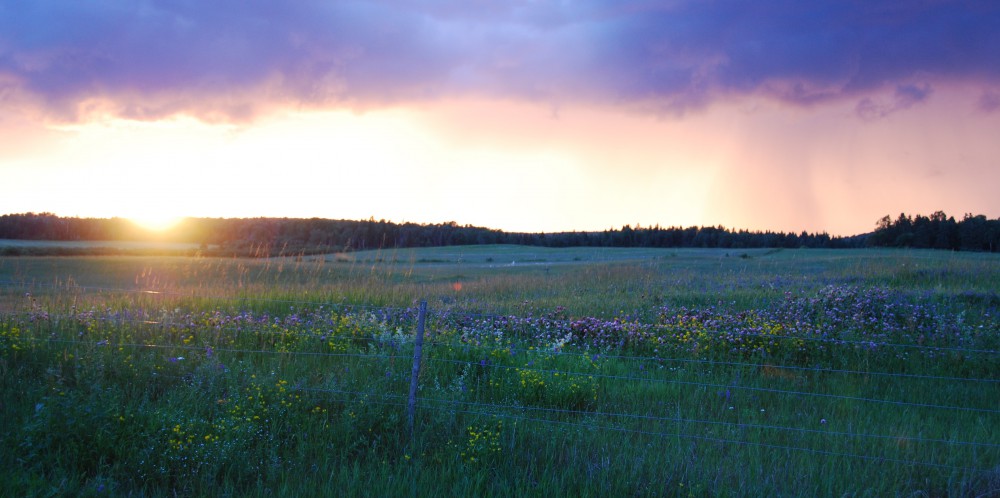
Mimicking natural systems – trying to make fields less like lawns, and more like prairies – is a growing focus in grassland agriculture. Rather than grow two or three plant species in a hayfield, for example, why not grow a far more diverse mix of plants in a pasture? It’s a small step, maybe, but it signals a shift away from the thoroughly artificial and highly-simplified landscapes that came with the plough.
But as we try to make agriculture more natural, we’re challenged by our own ignorance. Even now we know so little about the teeming life of the soil, and the interactions of plants, animals, insects, fungi and microbes. We know still less about how those landscapes functioned before they were remade by industrial agriculture.
That’s why a study of Bison in Yellowstone National Park published in late 2019 caught my attention. These animals are the closest thing to a wild, migratory herd remaining in the United States, and the way they graze offers lessons not only to park managers but to farmers and ranchers as well. Here’s a summary of the research, adapted from a story I wrote for the Ontario Farmer newspaper. After the story, I’ll add a few additional thoughts. By the way, “mob grazing” – referred to in the lead – is a technique cattlemen use to run large numbers of cattle on a small area for a brief period of intense grazing. The idea is to replicate the bison’s impact on the native prairie.
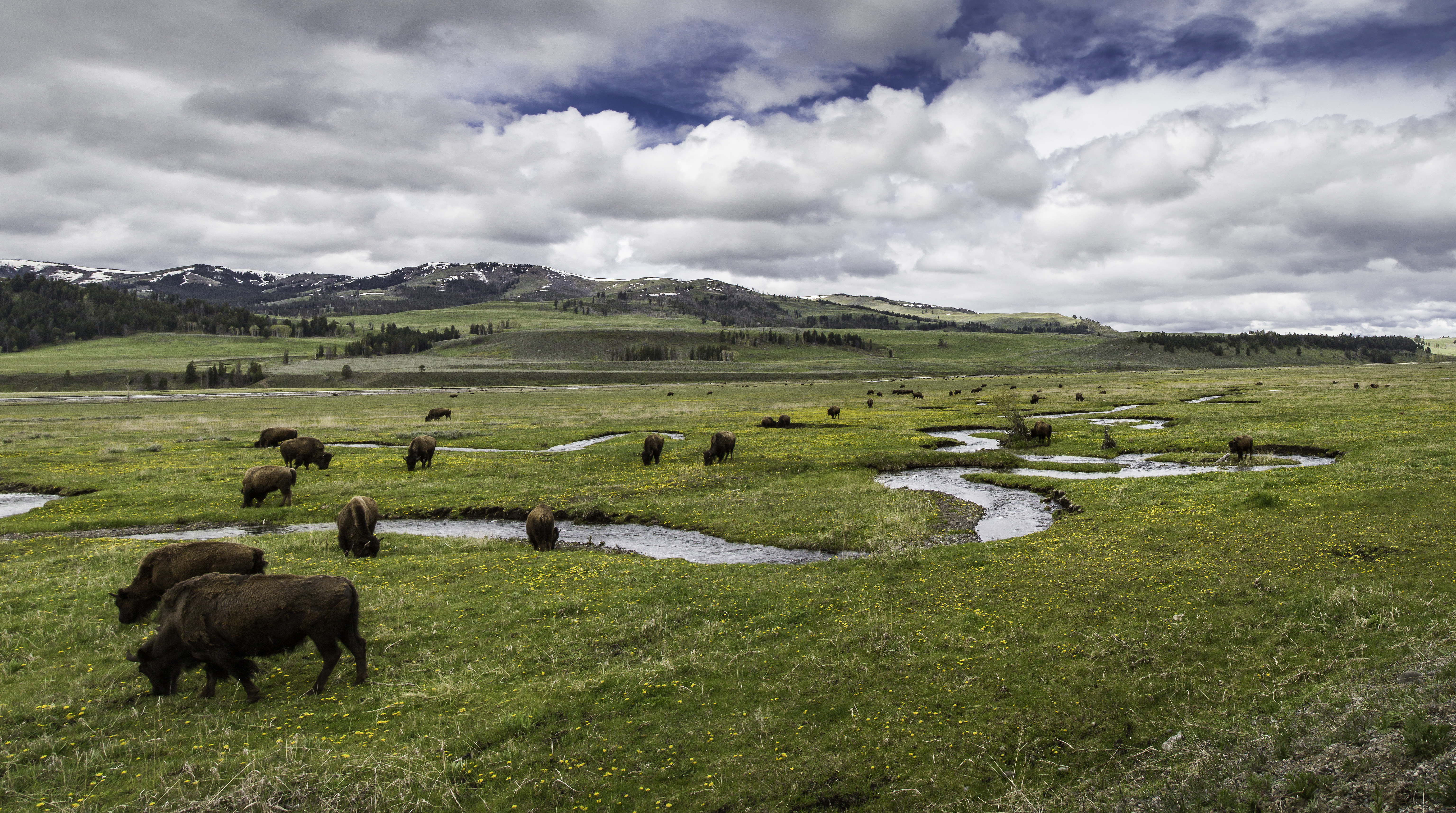
If you think “mob grazing” is a new idea, North America’s wild bison beg to differ. Research from Yellowstone National Park suggests the shaggy beasts may be among the continent’s most successful pasture managers – and they’ve never even attended grazing school.
In a multi-year project, U.S. researchers equipped members of the 5,500-head herd with GPS collars. After tracking their grazing behaviour and sampling dung to get a handle on nutrient consumption, researchers argue bison are “ecosystem engineers, capable of modifying grasslands” through intensive grazing. In other words, the bison aren’t just moving to find forage, they’re actively reshaping the landscape, and in the process changing their own migration patterns.
Large herds of Bison create “grazing lawns” that “green up faster, more intensely, for a longer duration” than other grassland areas, says the article in the Proceedings of the National Academy of Sciences. By mid-to-late summer, the herd’s grazing pressure “improved forage quality by 50-90 per cent in plots with high bison use,” the report adds. “In places where bison grazed intensely, they maintained forage in a high-quality state beyond the spring green-up period.”
For range and pasture managers, this is intriguing stuff. One of the concepts behind modern managed grazing involves mimicking the behaviour of wild grazers to achieve a more sustainable forage output. Classic techniques include brief periods of fairly intense grazing, followed by rest time to help the grass recover.
The Yellowstone herd seems to be putting their own stamp on this approach, combining relatively high stocking rates (for wild animals) with frequent movement. The payoff is higher grass productivity and nutrition levels, more late-season grass growth, and earlier greenup the following spring.
With bison “continually grazing on the latest growth of grass, the plants stay in a shorter, less-mature state,” says University of Wyoming zoology professor Jerod Merkle, a member of the Yellowstone research team.
The resulting “grazing lawns” feature grass that’s more palatable and nutritious than areas with mature grass. Meanwhile, the bison remove thatch on the pasture, and lay down a heavy pasting of dung and urine.
All that fertilizer seems to put the natural nutrient cycling system into overdrive. “The insect community (and whatever else) really takes care of the manure very quickly – within one year,” Merkle adds. “One hypothesis is that the recycling organisms are a bit more robust in these grazing lawns and facilitate getting the summer dung piles back into the soil quite efficiently.”
As the bison shift across the park, they create a diverse mosaic ranging from heavily-grazed zones to areas that are lightly grazed or left alone. With hundreds of buffalo looking for grass, some areas “end up with a pretty uniform amount of grazing,” Merkle adds. “My hunch is that in some small areas, those grasses get hammered (especially in certain years) and continually get bitten off during spring and early summer. But in other areas, bison might graze them once early in the year, and never come back.”
It’s an open question whether bison return to grazing lawns for repeated nibbles or clean off the forage and then move on for a year or longer. The team is working on the answer. “Stay tuned,” Merkle says.
By creating grazing lawns, bison are acting in a different way than other migratory grazers, including mule deer. The deer follow the “green wave” of new grass every spring as it ripples from Yellowstone’s valleys up its alpine areas. Bison surf the wave early in the season, but then tend to settle down on the lawns to take advantage of reliable fodder with less travel.
In Africa, wildebeests play a similar role, but the Yellowstone paper marks “one of the first times we’ve seen this in North America,” says University of Georgia wildlife management professor Michel Kohl.
Kohl wasn’t involved in the Yellowstone work, but he has compared bison and cattle grazing behaviour in Saskatchewan’s Grassland National Park. For wildlife biologists and native prairie managers, the Yellowstone findings are “interesting in a lot of ways,” he adds. “One of the cool parts is showing how bison extend the growing season.”
Understanding more about bison behaviour is an obvious plus for wilderness managers seeking to run vast western parks in a more natural way. But Kohl says there could be lessons for cattlemen and bison producers, too. “The idea is if we use cattle to graze more like bison, the system will respond better,” he says. That could mean healthier grass, economic gains for producers, and better wildlife habitat, too.
For Merkle, the message for graziers is to “keep the cattle in groups of relatively high density, but keep them on the move.”
At the same time, wild bison once operated on much vaster scale than today’s domesticated farmed bison, or even cattle on large ranches. “To actually reveal the full ecosystem function of bison, small herds confined to small areas just aren’t going to cut it,” Merkle says. “Our work suggests that bison need to be able to graze in large numbers in large areas.”
A few final thoughts…
Bison weren’t engineering the landscape on their own — their activities were tracked and guided by the indigenous peoples who relied so heavily on the shaggy beasts. Plains First Nations burned patches of prairie to create prime grazing. In the years before horses were available, they steered herds towards cliffs where they could be killed and butchered. (For an example of one well-known site in Canada see: https://headsmashedin.ca/about-head-smashed-buffalo-jump-world-heritage-site.)
When I showed the Yellowstone paper to Royal Alberta Museum archeaologist Jack Brink, he immediately thought of the implications for indigenous hunters:
“There are some strong implications regarding the conclusions of the paper and the way people might have hunted bison – because of course hunters were on foot for at least 13,000 years before they got horses and bison are wildly faster than humans on foot, so being able to predict where herds are going to go would be hugely important to pedestrian hunters,” Mr. Brink wrote in an e-mail. “You need to intercept herds in order to hunt them, so it becomes critical to not just know where herds can be found but to also know where they are moving next, and after that. You could take the implications of this paper – of bison actually altering the progression of the Green Wave – and plug that into a specific landscape and possibly predict where herds would linger the longest or move through more quickly.”
It’s worthwhile adding that long before Europeans ventured onto the scene, humans and bison were, together, sculpting and altering the western landscape. Estimates of the herd range as high as 60 million, but in this article, Canadian researchers estimate up to 30 million bison, with 130,000 people relying on them during “prehistoric and early historic times.”
One other observation: to support these tremendous herds (not to mention other wildlife), the prairies must have been remarkably productive, especially for a such a relatively arid zone. Part of the advantage came from deep and fertile soils, the product of glaciation and the steady accumulation of organic matter from thousands of years of grass growth. But unlike modern agriculture, the nutrients in the soil weren’t being transported very far. True, the bison were shuffling them about during migrations, but the nutrients eventually ended up more or less in the same neighbourhood. Bison grazing lawns, for example, could be hit hard by heavy grazing, but they also benefited from the manure and dung the animals brought. That’s a sharp contrast to today’s crop systems, where nutrients are harvested as grain and shipped to consumers in distant cities or overseas, never to return. Meanwhile, replacement nutrients are manufactured with natural gas, or dug out of the ground and shipped hundreds or thousands of kilometres.
 Empire of grass