When a series of crop failures nearly broke his family farm, North Dakota farmer Gabe Brown transformed the way he coaxed food from the soil. Gone was the emphasis on a few key commodities, including cereal grains. Gone was a heavy reliance on fertilizers, and trusting conventional wisdom.
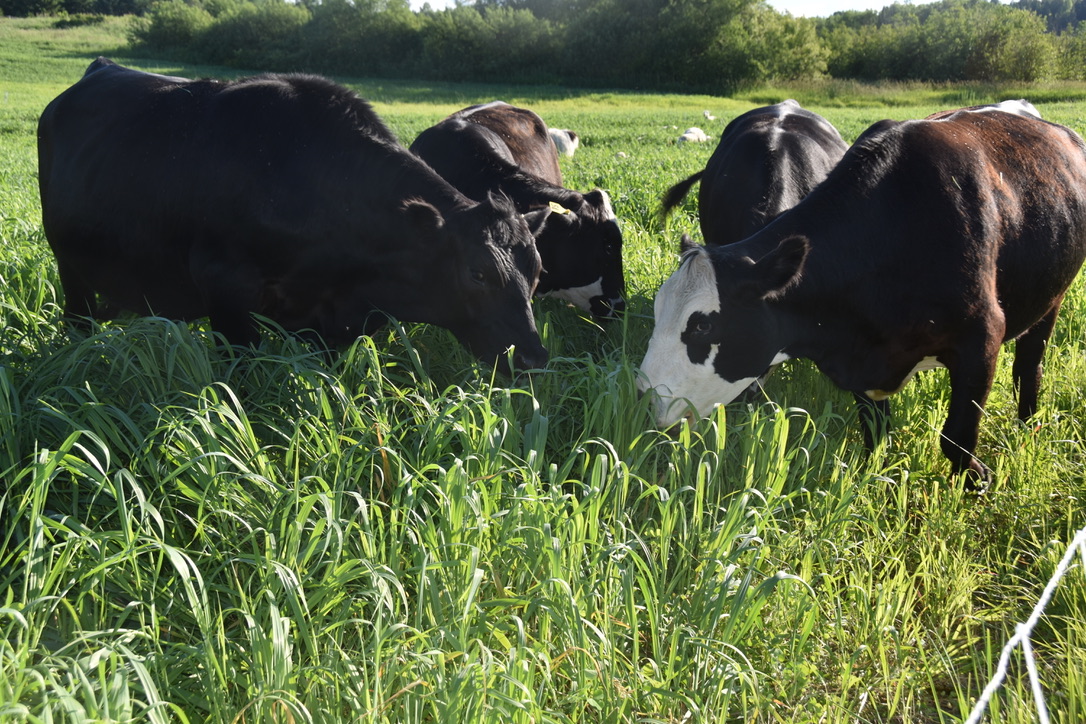
Instead, Brown embraced risk. He shifted to growing a wide range of cool-and warm-season crops, from buckwheat to sorghum to sunflowers. He sowed complex mixtures of plants to keep the soil covered and mimic the diversity of North Dakota’s natural prairies. He also expanded the cow herd to take advantage of that additional autumn and winter grazing. “Instead of harvesting by mechanical means, we use our cow herd to harvest for us,” he told the U.S. magazine, No-Till Farmer, in 2008.
Today Brown’s an influential figure in regenerative agriculture. His most repeated suggestion is to try new things – throw a lot of stuff against the wall and see what sticks. “We want to fail at something on this farm every year,” he said in that 2008 interview. “If I don’t fail at something, I’m not trying hard enough.”
Call me a Canadian, but I want my risks managed. I prefer to fail on a small scale, so it won’t threaten bankruptcy. I try out new stuff in fields hidden at the back of the farm. Why invite derision by failing in a roadside field? But for the past two years I took the Gabe Brown challenge. I courted failure – in a roadside field, no less.
The problem:
A played-out ten-acre hay and pasture infested with smooth bedstraw (Galium mollugo). Because our acidic soils benefit from adding lime to improve the pH, I opted to plough the field to work the lime in, kill the bedstraw and prepare the new seed bed. I split the field in half to try out two treatments, in successive years, in adjacent five-acre plots.
Bedstraw can’t be controlled with a one-and-done field renovation. The first round of tillage or herbicide might kill adult plants, but the plant leaves millions of tiny seeds in the topsoil, ready to germinate the following season. To counter, I opted for a two-year strategy: first, conventional fall ploughing to kill bedstraw, terminate the existing perennial stand, and incorporate lime before sowing an annual forage crop. Finally, in the second year of the process, the field is tilled again and a perennial hay/pasture mix is seeded.
Treatment one – 2021
The field received lime and potash as per the soil test. After fall ploughing in 2020 and spring tillage in 2021, custom operator Richard Emmott drilled in a mix of winter barley, Meroa Italian ryegrass, and crimson clover.
Why winter barley? Because the crop requires a cold period to set seed (and is normally planted in the autumn for harvest the following year) it stays green and palatable during its first season. Its heavy root system also benefits soil health and suppresses weed seedlings. (Winter triticale was another option considered, but my seed supplier was able to find the barley instead.)
In practice, the barley was slow to establish. When grazing started in early July, the cattle and sheep loved it and it offered high-quality, low-fibre feed. Unfortunately, it was also prone to rust, a common fungal disease of grasses. Rusted plants were dying by the second grazing in late August and the barley had virtually disappeared by the final pass in the fall. On the plus side, the Italian ryegrass filled in the gap, stayed green, and grew aggressively through most of the autumn.
Treatment two – 2022
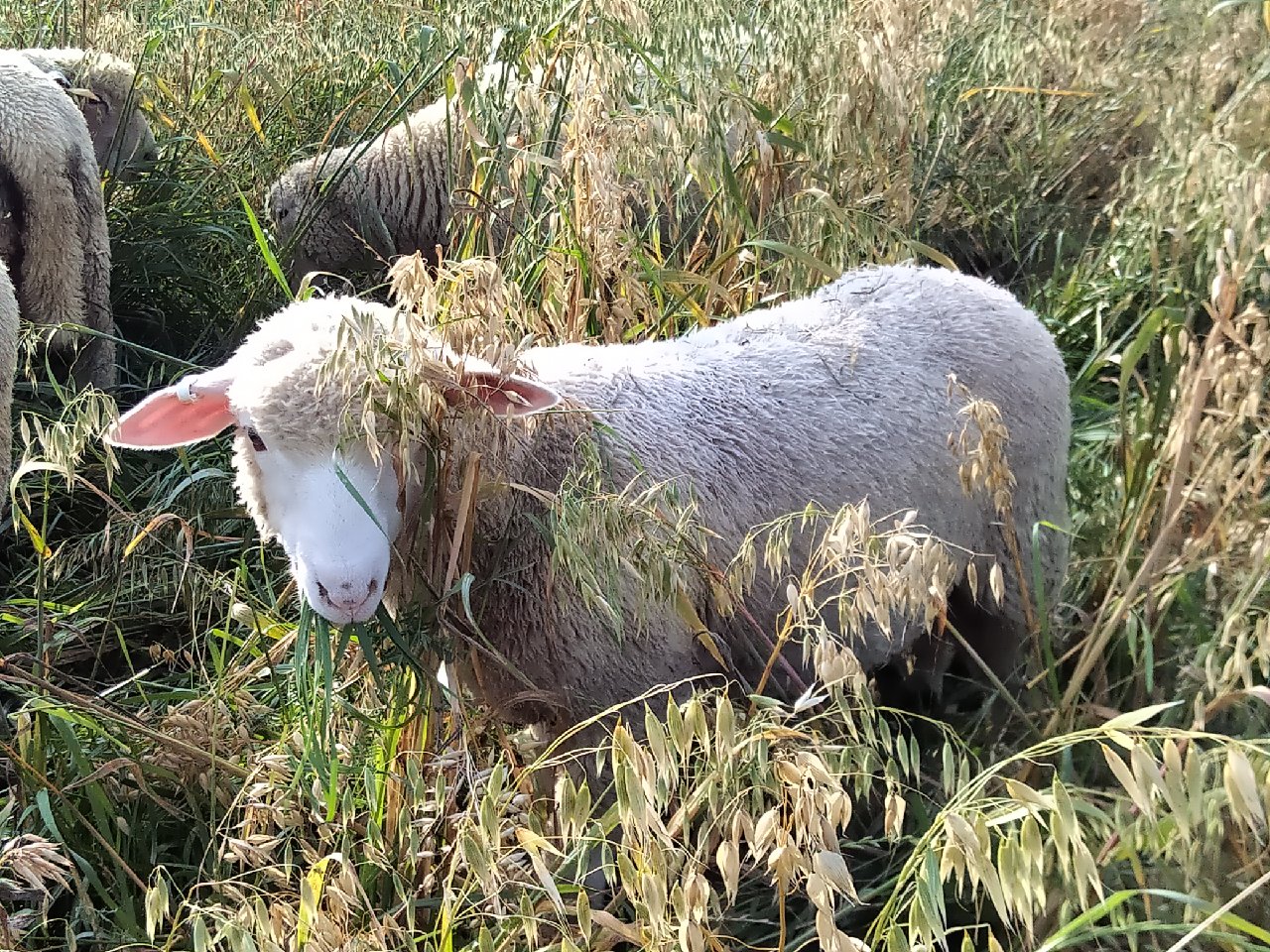
Two changes from the year before: The addition of a small amount of 21-10-22 fertilizer (at about 20 pounds nitrogen per acre) as a starter, and, more importantly, a switch from winter barley to CDC Haymaker forage oats. Developed at the University of Saskatchewan as an oat for hay, silage, or grazing, wide-leaved Haymaker has good rust resistance and higher yield than winter barley. It’s not quite the rocket fuel that winter barley is, but it still featured good palatability.
But with grazing oats, you have to work with the plant’s schedule, grazing early and often to keep the plant in its vegetative state. I messed up by delaying grazing until late June, when the oats were already well advanced. Even after heavy grazing the plants bounced back and started to set seed. By the time the stock returned to the field at the start of September, the oats were maturing.
This presented tough choices. I could try grazing, but I worried about grain overload from animals gorging on the oats. I mused about hiring someone to harvest and ensile the crop in wrapped bales, or even ploughing the whole thing down as “green manure.” In the end, I strip-grazed animals through the acreage, moving them four times a day to ration out the grain.
In return I got a lot of grazing from a small area – more than two weeks of grazing over about six acres. Animal performance was decent, especially on the cattle. If gain was the only goal, the group would have been moved more quickly and left more residue. But to improve ploughing conditions, I cleaned up as much fodder as possible. Long story short: two grazing passes of the oats yielded more feed than three passes with winter barley. And in both cases the ryegrass and clover did a nice job of filling in the stand and helping suppress weeds.
The takeaway:
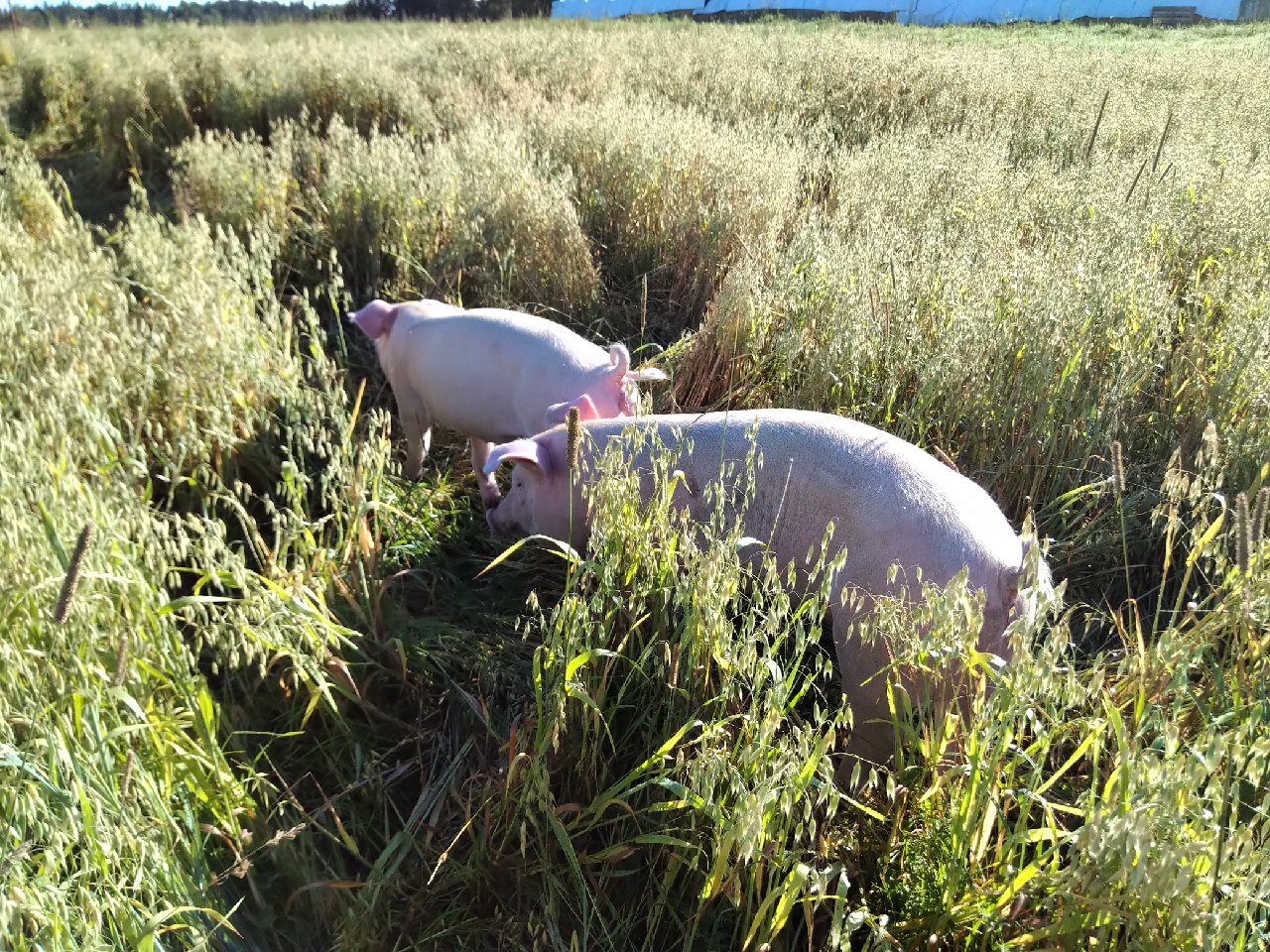
Forage oats make an excellent grazing option in my relatively-cool northeastern Ontario climate. In the future, I’ll try to be more flexible and graze the oats in their green or “milk” stage (before the grain hardens). Even when the oats mature, I’ll opt for strip-grazing. Since I lack easy access to a corn planter, strip-grazing oats probably makes a more convenient option than strip-grazing standing corn. (It also makes an excellent forage for pastured pigs.)
And grain overload? I certainly lost some sleep fretting over it. I put a bale of hay out in the field to provide more fibre. I made sure there was lots of grass to eat in the stand and I watched the stock like a hawk. But I didn’t really see any problems. After a few days of transition the critters figured it out and regulated their intake, nipping some of the heads off the oats and then filling up on ryegrass.
So thanks, Gabe Brown, for pushing farmers to try new stuff. Experimenting with oats and barley was a lot of fun. I look forward to more managed risks – and, yes, even small-scale, managed failures – in the future.
-30-
 Empire of grass