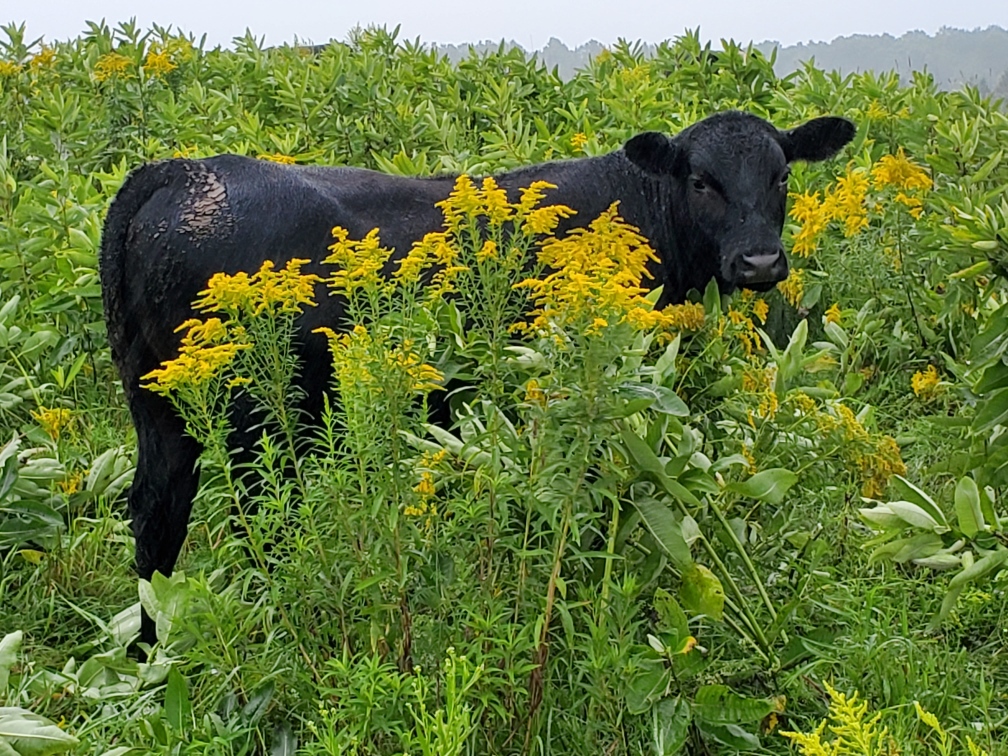
Perhaps you missed it, but members of the Monarch butterfly conservation community were aflutter with big news earlier this year. Cows, according to a recent study out of Nebraska, eat milkweed.
They may not like it, exactly, but if there’s a side of common milkweed on their plate, cattle “don’t mind it, that’s for sure,” says Timothy Dickson, Associate Professor of Biology at the University of Nebraska in Omaha. “We found pretty consistently they’re eating (milkweed) at least as much as the grass around it.”
This is a shocking turnabout from accepted wisdom. Milkweed’s long being considered a bitter, toxic and, for some species at least, a potential deadly meal for cattle and sheep. That, and its old-time habit of colonizing and persisting in crop fields put the weed on farmers’ Public Enemy list decades ago. In farm country, its bad reputation lingers.
But when Dickson tracked cow-calf pairs on up to 450 acres of range, they apparently hadn’t got the memo. The areas were managed with “patch-burn grazing,” a technique that mimics natural prairie fires by burning portions of the range in early spring. When succulent new growth appeared in the burned areas – including common and showy milkweed – cattle literally ate it up.
Which got Dickson and his research team thinking: If cows and milkweed can coexist, could that aid the survival of the imperilled Monarch? As butterfly lovers must know, milkweed offers the only nursery and food source for larval Monarchs. The insect’s survival is inextricably linked with the health of milkweed stands, and the continued existence of milkweed on the landscape.
Milkweed’s secret sauce – and the reason it’s beloved by Monarchs and unloved by graziers – lies in the chemical compounds the plant evolved to deter pests. While coffee and tea developed caffeine to fend off herbivores (and in the process made mornings more bearable for millions of humans), milkweed took a different approach, lacing its bitter, gluey sap with cardenolides – steroidal compounds that affect heart function.
As a plant defence, it more or less works, depending on the species. Some southern milkweed species lean towards the “more” side, with very high levels of cardenolides that can kill unlucky grazers. Fortunately for Canadians, most of our domestic pasture milkweeds are on the “less” side. Common milkweed (Asclepias syriaca), for example, has about 150 times fewer cardenolides than the highly toxic desert milkweeds of Mexico and the southwestern U.S.
So where does the fear of milkweed come from? Dickson points to agricultural studies, mostly conducted in the 1920s and 1940s, where researchers fed very high levels of milkweed to livestock, mostly sheep. The animals tended to sicken when milkweed constituted more than two per cent of their diet. But as Dickson says, few critters on a well-managed pasture will ever see that amount of milkweed or be forced to eat it with no alternative.
“We have not found a single published account of cattle or sheep death when milkweed made up less than two percent of available forage,” he wrote in the scientific journal, Rangeland Management and Ecology.
Dickson’s research echoes the experience of others. “I’ve watched a situation where a herd of cattle took down a big stand of milkweed in Idaho, and they were as happy as clams,” says Mace Vaughan, co-Director of Pollinator Conservation and Agricultural Biodiversity for the U.S.-based Xerces Society for Invertebrate Conservation. In 15 years of asking about deaths due to milkweed toxicity, Vaughn adds, “the only example that comes up is in sheep, with verticillata” or Whorled Milkweed.
On the other hand, Vaughan understands why farmers would fret about harbouring potentially poisonous plants on their property. “If people have concerns, I get that. You don’t want to sit there worrying about milkweed.”
On the question of livestock access to milkweed, I’ve swung from laissez-faire to restrictive and back again. I have four or five isolated patches of common milkweed on my farm, mostly on sandy knolls. At first I ran the stock through those areas as I would with any other part of the farm. But after a “poor-doer” ewe dropped dead in a pasture with milkweed in it, I got a lot more careful. The death didn’t seem to be due to the two main concerns of shepherds, external predators and internal parasites. In the absence of an obvious culprit, I blamed milkweed.
After the death, sheep and cattle were fenced off from milkweed with temporary electric fencing. It was good for the monarchs, but led to more labour and expense for me and less forage for my stock. As the milkweed continued to expand, its spread compounded those drawbacks. (You’ll see more about this in the next post.)
Now, based on Dickson’s research, I’m putting livestock and milkweed together again. I’ll try to limit the herd and flock’s time with the plant, and ensure they have access to lots of grass. But grazing low levels of milkweed offers a trio of benefits: better pasture utilization for me, habitat for monarchs, and some modest control of the aggressive weed’s spread.
Exactly why cattle seemed to enjoy a weed that has a bitter, toxic reputation remains unclear. Grazing animals like variety, so it’s not unheard of for them to try a range of items in the on-field salad bar. Plants with toxic compounds may also offer medicinal or parasite-control benefits when consumed in low levels. A recent nutritional survey found common milkweed at the flowering stage is competitive with other warm-season range grasses, boasting over 15 per cent protein, with good levels of calcium, phosphorus, potassium, magnesium, copper, zinc, manganese, and iron.
So maybe milkweed, consumed sparingly, offers a nice side dish for sheep and cattle. And since cattle are already controlling the weed through grazing, Disckson says, “the common practice of using herbicide to control common/showy milkweed does not appear to be an effective use of ranchers’ time and money where milkweed abundance is low.”
“Future research should examine ways for milkweed to better coexist with livestock grazing,” he adds. Done right, cows, monarchs and milkweed might get along after all.
-30-
 Empire of grass