Got milkweed? How I learned to love (or at least live with) milkweed, Part 1.

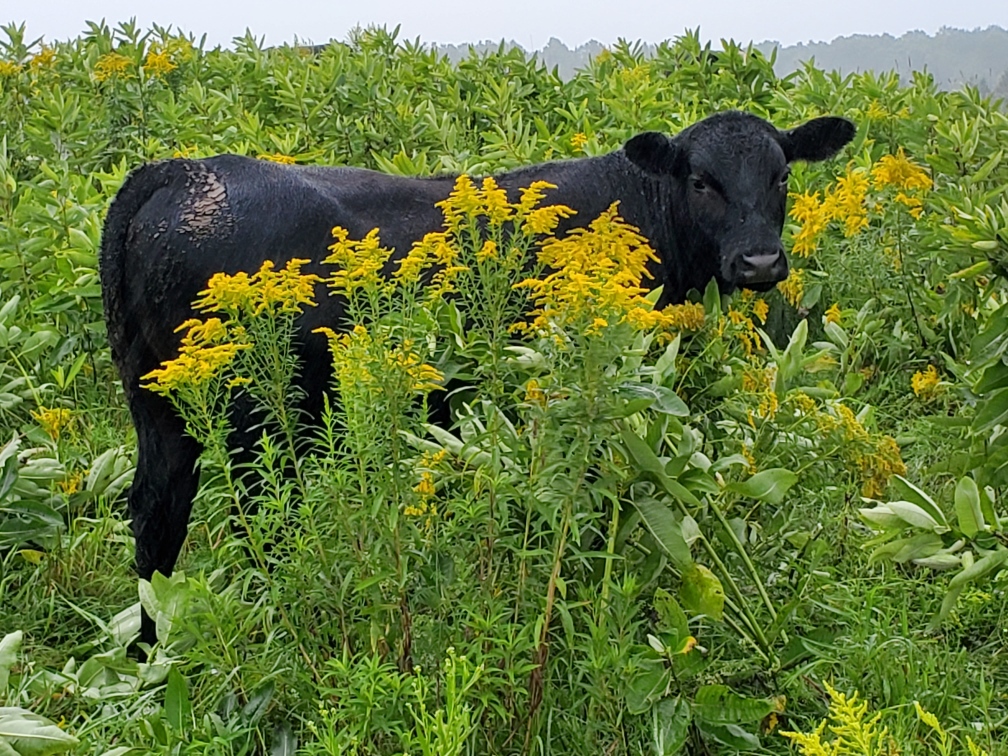
Perhaps you missed it, but members of the Monarch butterfly conservation community were aflutter with big news earlier this year. Cows, according to a recent study out of Nebraska, eat milkweed.

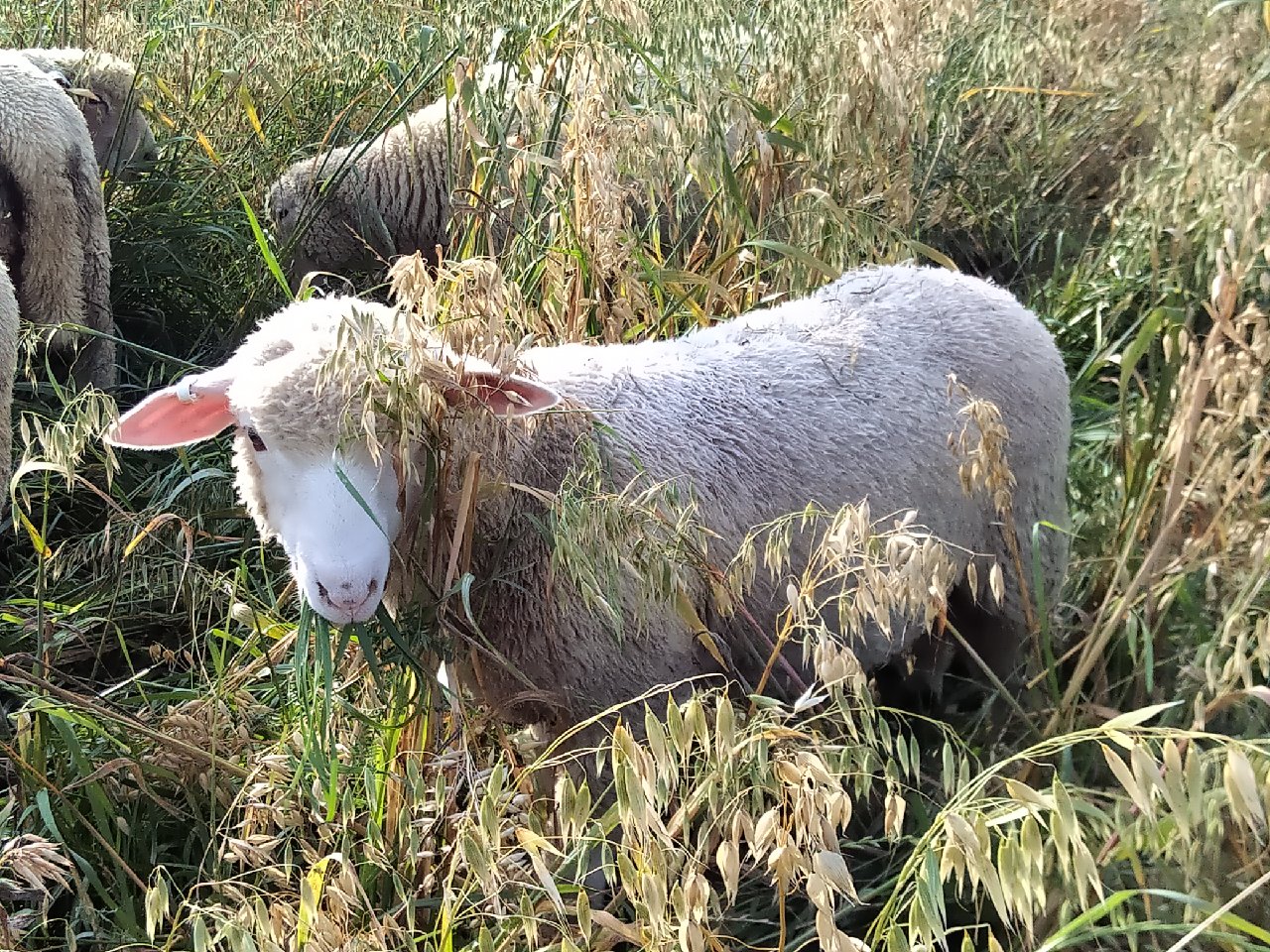
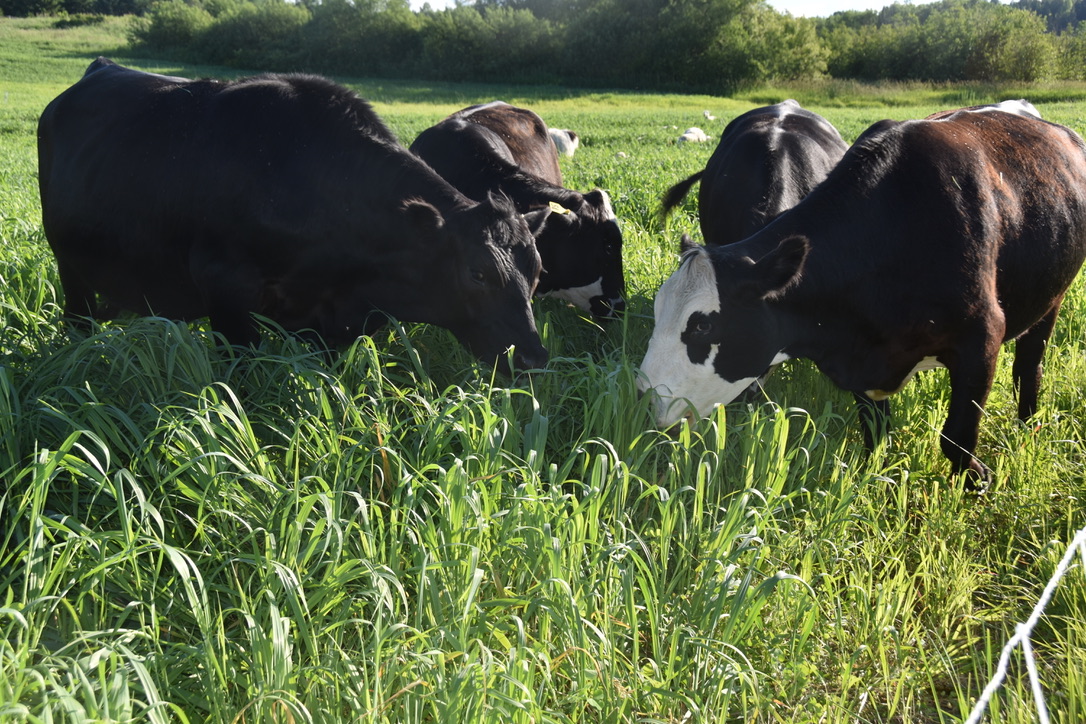
They may not like it, exactly, but if there’s a side of common milkweed on their plate, cattle “don’t mind it, that’s for sure,” says Timothy Dickson, Associate Professor of Biology at the University of Nebraska in Omaha. “We found pretty consistently they’re eating (milkweed) at least as much as the grass around it.”

This is a shocking turnabout from accepted wisdom. Milkweed’s long being considered a bitter, toxic and, for some species at least, a potential deadly meal for cattle and sheep. That, and its old-time habit of colonizing and persisting in crop fields put the weed on farmers’ Public Enemy list decades ago. In farm country, its bad reputation lingers.

But when Dickson tracked cow-calf pairs on up to 450 acres of range, they apparently hadn’t got the memo. The areas were managed with “patch-burn grazing,” a technique that mimics natural prairie fires by burning portions of the range in early spring. When succulent new growth appeared in the burned areas – including common and showy milkweed – cattle literally ate it up.

Which got Dickson and his research team thinking: If cows and milkweed can coexist, could that aid the survival of the imperilled Monarch? As butterfly lovers must know, milkweed offers the only nursery and food source for larval Monarchs. The insect’s survival is inextricably linked with the health of milkweed stands, and the continued existence of milkweed on the landscape.

Milkweed’s secret sauce – and the reason it’s beloved by Monarchs and unloved by graziers – lies in the chemical compounds the plant evolved to deter pests. While coffee and tea developed caffeine to fend off herbivores (and in the process made mornings more bearable for millions of humans), milkweed took a different approach, lacing its bitter, gluey sap with cardenolides – steroidal compounds that affect heart function.

As a plant defence, it more or less works, depending on the species. Some southern milkweed species lean towards the “more” side, with very high levels of cardenolides that can kill unlucky grazers. Fortunately for Canadians, most of our domestic pasture milkweeds are on the “less” side. Common milkweed (Asclepias syriaca), for example, has about 150 times fewer cardenolides than the highly toxic desert milkweeds of Mexico and the southwestern U.S.

So where does the fear of milkweed come from? Dickson points to agricultural studies, mostly conducted in the 1920s and 1940s, where researchers fed very high levels of milkweed to livestock, mostly sheep. The animals tended to sicken when milkweed constituted more than two per cent of their diet. But as Dickson says, few critters on a well-managed pasture will ever see that amount of milkweed or be forced to eat it with no alternative.

“We have not found a single published account of cattle or sheep death when milkweed made up less than two percent of available forage,” he wrote in the scientific journal, Rangeland Management and Ecology.

Dickson’s research echoes the experience of others. “I’ve watched a situation where a herd of cattle took down a big stand of milkweed in Idaho, and they were as happy as clams,” says Mace Vaughan, co-Director of Pollinator Conservation and Agricultural Biodiversity for the U.S.-based Xerces Society for Invertebrate Conservation. In 15 years of asking about deaths due to milkweed toxicity, Vaughn adds, “the only example that comes up is in sheep, with verticillata” or Whorled Milkweed.

On the other hand, Vaughan understands why farmers would fret about harbouring potentially poisonous plants on their property. “If people have concerns, I get that. You don’t want to sit there worrying about milkweed.”

On the question of livestock access to milkweed, I’ve swung from laissez-faire to restrictive and back again. I have four or five isolated patches of common milkweed on my farm, mostly on sandy knolls. At first I ran the stock through those areas as I would with any other part of the farm. But after a “poor-doer” ewe dropped dead in a pasture with milkweed in it, I got a lot more careful. The death didn’t seem to be due to the two main concerns of shepherds, external predators and internal parasites. In the absence of an obvious culprit, I blamed milkweed.

After the death, sheep and cattle were fenced off from milkweed with temporary electric fencing. It was good for the monarchs, but led to more labour and expense for me and less forage for my stock. As the milkweed continued to expand, its spread compounded those drawbacks. (You’ll see more about this in the next post.)

Now, based on Dickson’s research, I’m putting livestock and milkweed together again. I’ll try to limit the herd and flock’s time with the plant, and ensure they have access to lots of grass. But grazing low levels of milkweed offers a trio of benefits: better pasture utilization for me, habitat for monarchs, and some modest control of the aggressive weed’s spread.

Exactly why cattle seemed to enjoy a weed that has a bitter, toxic reputation remains unclear. Grazing animals like variety, so it’s not unheard of for them to try a range of items in the on-field salad bar. Plants with toxic compounds may also offer medicinal or parasite-control benefits when consumed in low levels. A recent nutritional survey found common milkweed at the flowering stage is competitive with other warm-season range grasses, boasting over 15 per cent protein, with good levels of calcium, phosphorus, potassium, magnesium, copper, zinc, manganese, and iron.

So maybe milkweed, consumed sparingly, offers a nice side dish for sheep and cattle. And since cattle are already controlling the weed through grazing, Disckson says, “the common practice of using herbicide to control common/showy milkweed does not appear to be an effective use of ranchers’ time and money where milkweed abundance is low.”

“Future research should examine ways for milkweed to better coexist with livestock grazing,” he adds. Done right, cows, monarchs and milkweed might get along after all.

-30-
Blending oat and science

When a series of crop failures nearly broke his family farm, North Dakota farmer Gabe Brown transformed the way he coaxed food from the soil. Gone was the emphasis on a few key commodities, including cereal grains. Gone was a heavy reliance on fertilizers, and trusting conventional wisdom.

Instead, Brown embraced risk. He shifted to growing a wide range of cool-and warm-season crops, from buckwheat to sorghum to sunflowers. He sowed complex mixtures of plants to keep the soil covered and mimic the diversity of North Dakota’s natural prairies. He also expanded the cow herd to take advantage of that additional autumn and winter grazing. “Instead of harvesting by mechanical means, we use our cow herd to harvest for us,” he told the U.S. magazine, No-Till Farmer, in 2008.

Today Brown’s an influential figure in regenerative agriculture. His most repeated suggestion is to try new things – throw a lot of stuff against the wall and see what sticks. “We want to fail at something on this farm every year,” he said in that 2008 interview. “If I don’t fail at something, I’m not trying hard enough.”

Call me a Canadian, but I want my risks managed. I prefer to fail on a small scale, so it won’t threaten bankruptcy. I try out new stuff in fields hidden at the back of the farm. Why invite derision by failing in a roadside field? But for the past two years I took the Gabe Brown challenge. I courted failure – in a roadside field, no less.

The problem:

A played-out ten-acre hay and pasture infested with smooth bedstraw (Galium mollugo). Because our acidic soils benefit from adding lime to improve the pH, I opted to plough the field to work the lime in, kill the bedstraw and prepare the new seed bed. I split the field in half to try out two treatments, in successive years, in adjacent five-acre plots.

Bedstraw can’t be controlled with a one-and-done field renovation. The first round of tillage or herbicide might kill adult plants, but the plant leaves millions of tiny seeds in the topsoil, ready to germinate the following season. To counter, I opted for a two-year strategy: first, conventional fall ploughing to kill bedstraw, terminate the existing perennial stand, and incorporate lime before sowing an annual forage crop. Finally, in the second year of the process, the field is tilled again and a perennial hay/pasture mix is seeded.

Treatment one – 2021

The field received lime and potash as per the soil test. After fall ploughing in 2020 and spring tillage in 2021, custom operator Richard Emmott drilled in a mix of winter barley, Meroa Italian ryegrass, and crimson clover.

Why winter barley? Because the crop requires a cold period to set seed (and is normally planted in the autumn for harvest the following year) it stays green and palatable during its first season. Its heavy root system also benefits soil health and suppresses weed seedlings. (Winter triticale was another option considered, but my seed supplier was able to find the barley instead.)

In practice, the barley was slow to establish. When grazing started in early July, the cattle and sheep loved it and it offered high-quality, low-fibre feed. Unfortunately, it was also prone to rust, a common fungal disease of grasses. Rusted plants were dying by the second grazing in late August and the barley had virtually disappeared by the final pass in the fall. On the plus side, the Italian ryegrass filled in the gap, stayed green, and grew aggressively through most of the autumn.

Treatment two – 2022

Grazing in early September, when oats are a little too mature.

Two changes from the year before: The addition of a small amount of 21-10-22 fertilizer (at about 20 pounds nitrogen per acre) as a starter, and, more importantly, a switch from winter barley to CDC Haymaker forage oats. Developed at the University of Saskatchewan as an oat for hay, silage, or grazing, wide-leaved Haymaker has good rust resistance and higher yield than winter barley. It’s not quite the rocket fuel that winter barley is, but it still featured good palatability.

But with grazing oats, you have to work with the plant’s schedule, grazing early and often to keep the plant in its vegetative state. I messed up by delaying grazing until late June, when the oats were already well advanced. Even after heavy grazing the plants bounced back and started to set seed. By the time the stock returned to the field at the start of September, the oats were maturing.

This presented tough choices. I could try grazing, but I worried about grain overload from animals gorging on the oats. I mused about hiring someone to harvest and ensile the crop in wrapped bales, or even ploughing the whole thing down as “green manure.” In the end, I strip-grazed animals through the acreage, moving them four times a day to ration out the grain.

In return I got a lot of grazing from a small area – more than two weeks of grazing over about six acres. Animal performance was decent, especially on the cattle. If gain was the only goal, the group would have been moved more quickly and left more residue. But to improve ploughing conditions, I cleaned up as much fodder as possible. Long story short: two grazing passes of the oats yielded more feed than three passes with winter barley. And in both cases the ryegrass and clover did a nice job of filling in the stand and helping suppress weeds.

The takeaway:

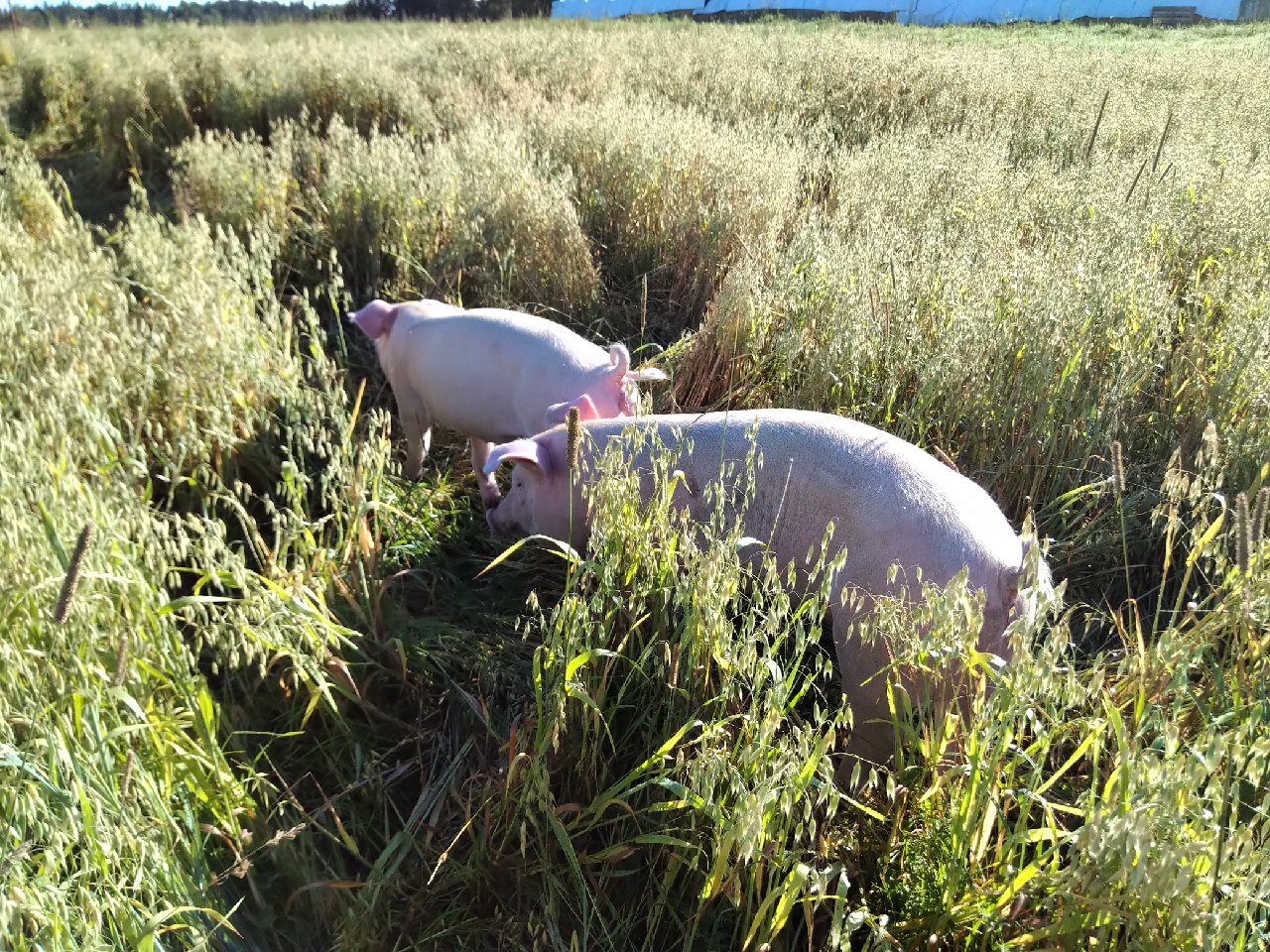
Forage oats make an excellent grazing option in my relatively-cool northeastern Ontario climate. In the future, I’ll try to be more flexible and graze the oats in their green or “milk” stage (before the grain hardens). Even when the oats mature, I’ll opt for strip-grazing. Since I lack easy access to a corn planter, strip-grazing oats probably makes a more convenient option than strip-grazing standing corn. (It also makes an excellent forage for pastured pigs.)

These piggies are feeling (and eating) their oats.

And grain overload? I certainly lost some sleep fretting over it. I put a bale of hay out in the field to provide more fibre. I made sure there was lots of grass to eat in the stand and I watched the stock like a hawk. But I didn’t really see any problems. After a few days of transition the critters figured it out and regulated their intake, nipping some of the heads off the oats and then filling up on ryegrass.

So thanks, Gabe Brown, for pushing farmers to try new stuff. Experimenting with oats and barley was a lot of fun. I look forward to more managed risks – and, yes, even small-scale, managed failures – in the future.

-30-

You steal my sunshine

We live in a galactic sweet spot, on the Goldilocks planet that’s just right. So far as we know, this really is the best of all possible worlds.

The forces that make our situation so clement are complex, but the distance from the sun, the Earth’s size and spin, the shifting continents and ocean currents, even the stabilizing impact of the moon all combine to produce this liveable blue-green sphere. When you look at our neighbours – cold and dusty Mars, smoggy, hothouse Venus – we should be grateful.

Humans being what we are, though, we take a lot for granted. For centuries, maybe millennia, we’ve been conducting an unintentional experiment with our home, altering its atmosphere in ways that seem subtle, but have – and likely will have – planet-altering results. Now, with climate change projected to boost global average temperatures by roughly 1.5-4 degrees C by the end of the century, some are advocating planet-changing experiments that are intentional.

The concept is “geoengineering.” It’s a bit like the Old Lady of the children’s song – the one that swallows the spider (and so on) to get rid of the fly she initially ingested. In this case, we’re talking about slowing or reversing the warming we’ve already caused. Ideas include releasing sun-blocking sulphates from high-flying tanker aircraft; launching massive arrays of mirrors into space to block a small percentage of the sun’s incoming rays; or using ships to spray salt water into the air to whiten clouds and make them more reflective.

These ideas sound like something concocted in the lair of a James Bond villain. But with the atmosphere’s carbon dioxide levels continuing to climb, geoengineering is starting to look like a possible, (if risky) Plan B.

Consider, for example, the value of maintaining polar ice caps. Given their role in regulating global weather and climate, “the risks of doing nothing in the arctic are enormous,” says Hugh Hunt, engineering researcher and co-director of the University of Cambridge’s Centre for Climate Repair. The potential impact is dire enough that Mr. Hunt argues it’s time to investigate some of those “crazy ideas.” And not just in the lab, or through computer simulations. “We’re talking about going out in a ship and trying out ideas,” he says.

Tinkering with solar radiation is more than just fine-tuning the planetary thermostat. Along with potential impacts to rainfall patterns, weather and circulation – not to mention the feel of the sun on our own skin – sunshine fuels the food system.

Photosynthesis is a bit of a clumsy process (a topic worth covering in a future post,) but plants have spent millennia making it work. In the process they’ve remade the face of the Earth. Just one or two percent of all the solar energy reaching the earth falls in wavelengths plants can intercept, but that small fraction supplies the basic feedstock – the tissue and roots, the sugars, proteins, fats and amino acids – that virtually all life relies on.

Messing with that productivity, even in subtle ways, comes with obvious problems. If there’s less sun, won’t there be less plant growth, and ultimately less food for terrestrial insects, birds and animals? On the other hand, runaway warming imperils plant growth too, so how do we square these problems?

The answer, based on initial research into the impact of sulphates in the atmosphere, is unlikely to be clear-cut. When a major volcanic eruption lofts sun-blocking particles high into the atmosphere, those aerosols scatter and diffuse the light.

Perennial plants with lots of leaves take advantage of this diffuse, more evenly distributed light to crank up photosynthesis. After the 1991 eruption of the Philippine volcano Mount Pinatubo, leaves in the forest understory got more light than they otherwise would have. The result seems to have been more plant growth overall, and a temporary decline in the growth of atmospheric carbon dioxide.

That sounds good for a pasture farmer like me, because perennial grasses do a good job of soaking up this diffuse light. But my neighbour growing oats or barley might have a far different result, based on the findings of a 2018 paper. By modelling the Pinatubo effect on a global scale, the research team found the dimming triggered by the eruption reduced yields of crucial annual crops like corn by 9.3 per cent, and by 4.8 per cent for C3 crops, such as wheat or rice.

Why the difference? Plant architecture probably has something to do with it. Annuals put more effort into producing grain or fruit. After all, they have only one year to accomplish their life cycle. Perennials, on the other hand, are here for the long haul. It makes sense for them to invest more in roots, stems and leaves.

But even if grass and trees grow better under a geoengineering scenario, we’re a species that relies heavily on annual crops. With less corn, rice, tomatoes and pumpkins, our diet could change in an unwelcome way.

The authors of the 2018 Pinatubo modelling article study argue potential yield losses due to geoengineering cancel out any agricultural benefit from cooling the climate. As researcher Jonathon Proctor told The Atlantic’s Robinson Meyer, “the side effects of the treatment—the changes in sunlight—are kind of just as bad as the original disease.”

In a culture that is increasingly rootless (pun completely intended), it’s easy to overlook the fundamental value of plants. But as a farmer whose life is literally built on plants and soil, I worry our society’s “plant blindness” will lead to bad policy choices.

Before we turn down the dimmer switch on Sol, let’s start with no-regrets solutions that work with the botanical world, not against it. Throttling back on carbon emissions is the obvious first step, but there are “soft” geoengineering approaches too, including improving forest health. Or, in my case, working with better grazing techniques that not only help feed people, but put more carbon in the soil.

Because Earth isn’t just the best of all possible worlds. It’s our only option.

-30-

How the Buffalo Roamed

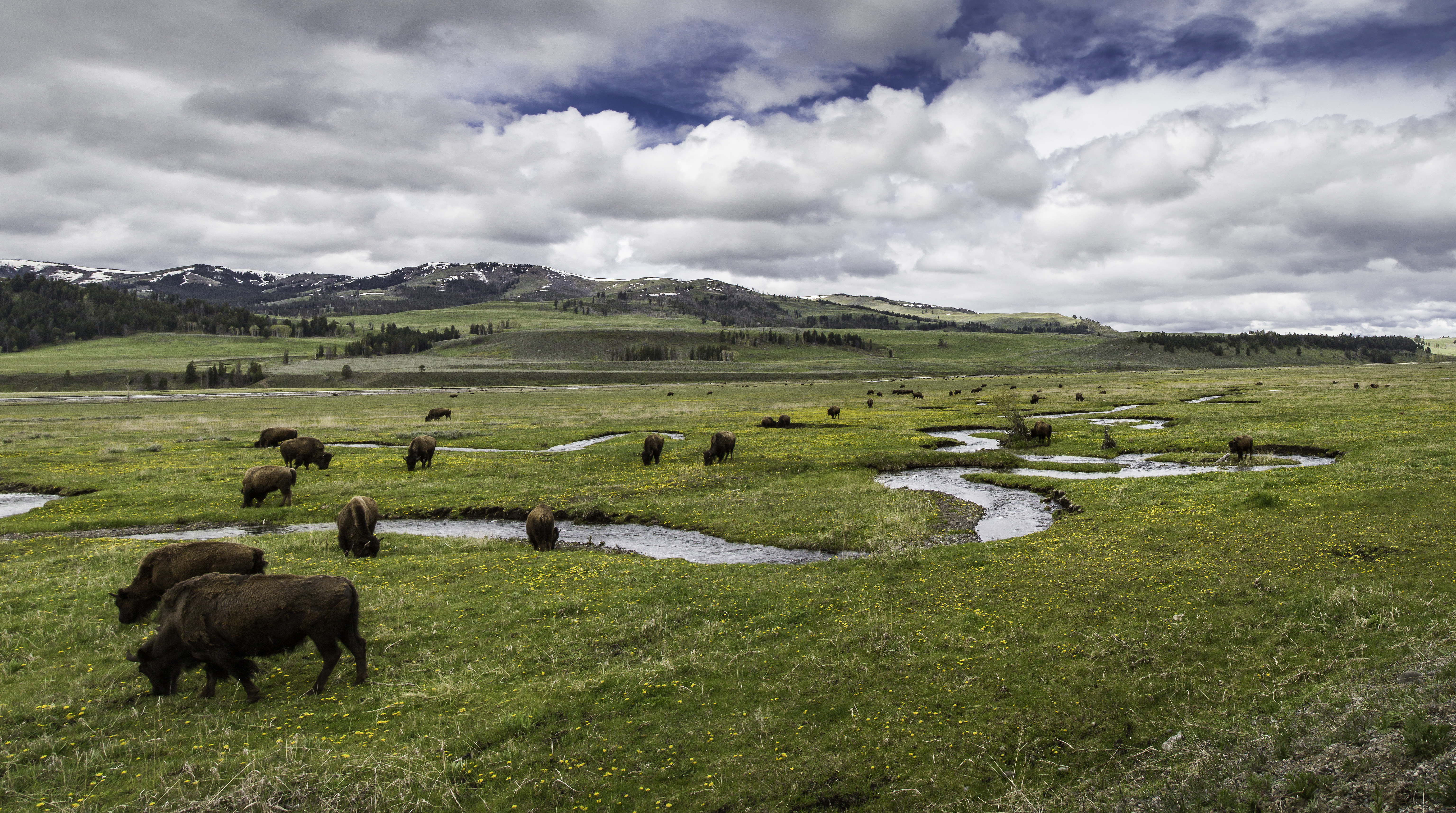
Bison near Rose Creek. Courtesy Yellowstone National Park.

Mimicking natural systems – trying to make fields less like lawns, and more like prairies – is a growing focus in grassland agriculture. Rather than grow two or three plant species in a hayfield, for example, why not grow a far more diverse mix of plants in a pasture? It’s a small step, maybe, but it signals a shift away from the thoroughly artificial and highly-simplified landscapes that came with the plough.

But as we try to make agriculture more natural, we’re challenged by our own ignorance. Even now we know so little about the teeming life of the soil, and the interactions of plants, animals, insects, fungi and microbes. We know still less about how those landscapes functioned before they were remade by industrial agriculture.

That’s why a study of Bison in Yellowstone National Park published in late 2019 caught my attention. These animals are the closest thing to a wild, migratory herd remaining in the United States, and the way they graze offers lessons not only to park managers but to farmers and ranchers as well. Here’s a summary of the research, adapted from a story I wrote for the Ontario Farmer newspaper. After the story, I’ll add a few additional thoughts. By the way, “mob grazing” – referred to in the lead – is a technique cattlemen use to run large numbers of cattle on a small area for a brief period of intense grazing. The idea is to replicate the bison’s impact on the native prairie.

If you think “mob grazing” is a new idea, North America’s wild bison beg to differ. Research from Yellowstone National Park suggests the shaggy beasts may be among the continent’s most successful pasture managers – and they’ve never even attended grazing school.

In a multi-year project, U.S. researchers equipped members of the 5,500-head herd with GPS collars. After tracking their grazing behaviour and sampling dung to get a handle on nutrient consumption, researchers argue bison are “ecosystem engineers, capable of modifying grasslands” through intensive grazing. In other words, the bison aren’t just moving to find forage, they’re actively reshaping the landscape, and in the process changing their own migration patterns.

Large herds of Bison create “grazing lawns” that “green up faster, more intensely, for a longer duration” than other grassland areas, says the article in the Proceedings of the National Academy of Sciences. By mid-to-late summer, the herd’s grazing pressure “improved forage quality by 50-90 per cent in plots with high bison use,” the report adds. “In places where bison grazed intensely, they maintained forage in a high-quality state beyond the spring green-up period.”

For range and pasture managers, this is intriguing stuff. One of the concepts behind modern managed grazing involves mimicking the behaviour of wild grazers to achieve a more sustainable forage output. Classic techniques include brief periods of fairly intense grazing, followed by rest time to help the grass recover.

The Yellowstone herd seems to be putting their own stamp on this approach, combining relatively high stocking rates (for wild animals) with frequent movement. The payoff is higher grass productivity and nutrition levels, more late-season grass growth, and earlier greenup the following spring.

With bison “continually grazing on the latest growth of grass, the plants stay in a shorter, less-mature state,” says University of Wyoming zoology professor Jerod Merkle, a member of the Yellowstone research team.

The resulting “grazing lawns” feature grass that’s more palatable and nutritious than areas with mature grass. Meanwhile, the bison remove thatch on the pasture, and lay down a heavy pasting of dung and urine.

All that fertilizer seems to put the natural nutrient cycling system into overdrive. “The insect community (and whatever else) really takes care of the manure very quickly – within one year,” Merkle adds. “One hypothesis is that the recycling organisms are a bit more robust in these grazing lawns and facilitate getting the summer dung piles back into the soil quite efficiently.”

As the bison shift across the park, they create a diverse mosaic ranging from heavily-grazed zones to areas that are lightly grazed or left alone. With hundreds of buffalo looking for grass, some areas “end up with a pretty uniform amount of grazing,” Merkle adds. “My hunch is that in some small areas, those grasses get hammered (especially in certain years) and continually get bitten off during spring and early summer. But in other areas, bison might graze them once early in the year, and never come back.”

It’s an open question whether bison return to grazing lawns for repeated nibbles or clean off the forage and then move on for a year or longer. The team is working on the answer. “Stay tuned,” Merkle says.

By creating grazing lawns, bison are acting in a different way than other migratory grazers, including mule deer. The deer follow the “green wave” of new grass every spring as it ripples from Yellowstone’s valleys up its alpine areas. Bison surf the wave early in the season, but then tend to settle down on the lawns to take advantage of reliable fodder with less travel.

In Africa, wildebeests play a similar role, but the Yellowstone paper marks “one of the first times we’ve seen this in North America,” says University of Georgia wildlife management professor Michel Kohl.

Kohl wasn’t involved in the Yellowstone work, but he has compared bison and cattle grazing behaviour in Saskatchewan’s Grassland National Park. For wildlife biologists and native prairie managers, the Yellowstone findings are “interesting in a lot of ways,” he adds. “One of the cool parts is showing how bison extend the growing season.”

Understanding more about bison behaviour is an obvious plus for wilderness managers seeking to run vast western parks in a more natural way. But Kohl says there could be lessons for cattlemen and bison producers, too. “The idea is if we use cattle to graze more like bison, the system will respond better,” he says. That could mean healthier grass, economic gains for producers, and better wildlife habitat, too.

For Merkle, the message for graziers is to “keep the cattle in groups of relatively high density, but keep them on the move.”

At the same time, wild bison once operated on much vaster scale than today’s domesticated farmed bison, or even cattle on large ranches.  “To actually reveal the full ecosystem function of bison, small herds confined to small areas just aren’t going to cut it,” Merkle says. “Our work suggests that bison need to be able to graze in large numbers in large areas.”

A few final thoughts…

Bison weren’t engineering the landscape on their own — their activities were tracked and guided by the indigenous peoples who relied so heavily on the shaggy beasts. Plains First Nations burned patches of prairie to create prime grazing. In the years before horses were available, they steered herds towards cliffs where they could be killed and butchered. (For an example of one well-known site in Canada see: https://headsmashedin.ca/about-head-smashed-buffalo-jump-world-heritage-site.)

When I showed the Yellowstone paper to Royal Alberta Museum archeaologist Jack Brink, he immediately thought of the implications for indigenous hunters:

“There are some strong implications regarding the conclusions of the paper and the way people might have hunted bison – because of course hunters were on foot for at least 13,000 years before they got horses and bison are wildly faster than humans on foot, so being able to predict where herds are going to go would be hugely important to pedestrian hunters,” Mr. Brink wrote in an e-mail. “You need to intercept herds in order to hunt them, so it becomes critical to not just know where herds can be found but to also know where they are moving next, and after that. You could take the implications of this paper – of bison actually altering the progression of the Green Wave – and plug that into a specific landscape and possibly predict where herds would linger the longest or move through more quickly.”

It’s worthwhile adding that long before Europeans ventured onto the scene, humans and bison were, together, sculpting and altering the western landscape. Estimates of the herd range as high as 60 million, but in this article, Canadian researchers estimate up to 30 million bison, with 130,000 people relying on them during “prehistoric and early historic times.”

One other observation: to support these tremendous herds (not to mention other wildlife), the prairies must have been remarkably productive, especially for a such a relatively arid zone. Part of the advantage came from deep and fertile soils, the product of glaciation and the steady accumulation of organic matter from thousands of years of grass growth. But unlike modern agriculture, the nutrients in the soil weren’t being transported very far. True, the bison were shuffling them about during migrations, but the nutrients eventually ended up more or less in the same neighbourhood. Bison grazing lawns, for example, could be hit hard by heavy grazing, but they also benefited from the manure and dung the animals brought. That’s a sharp contrast to today’s crop systems, where nutrients are harvested as grain and shipped to consumers in distant cities or overseas, never to return. Meanwhile, replacement nutrients are manufactured with natural gas, or dug out of the ground and shipped hundreds or thousands of kilometres.

Small, hopeful investments

IMG_20200321_1053348

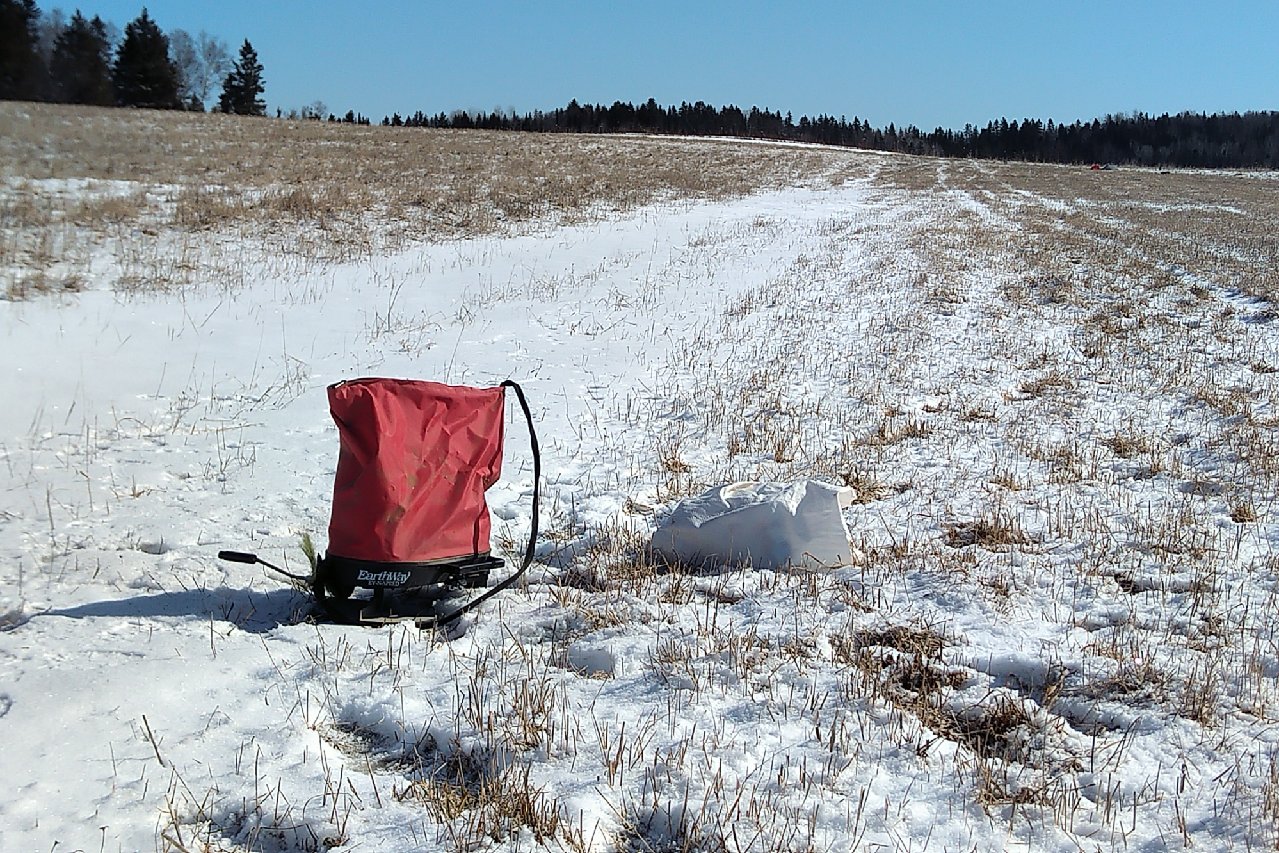
21st March 2020: A hand-cranked seeder, a bag of seed, and a snowy field: let the pasturing season begin!

The morning was so still that at sunrise, frost crystals glittered over the snow like diamond dust. The thermometer read -11 C. (12 F). True, this was a chilly Saturday in late March, but in a world on lockdown, I was glad to get out and sow seeds for the future.

“Frost-seeding” is the pasture farmer’s no-till seed drill, a way to get seed into the ground without the help of costly machines and thudding diesel engines. At its most basic, you walk atop a skiff of snow, spinning a flurry of seeds over the field with a hand-cranked cyclone seeder. The tiny packaged plants – red clover, bird’s-foot trefoil, white clover – help mark your path by landing as dark pinpoints in the snow.

Eventually, many of those seeds will work their way into the rooting zone. Freezing and thawing opens and closes the earth’s pores, while snow and rain drive those round and relatively heavy seeds into the soil’s embrace. When and if the seeds grow, they’ll nourish grazing livestock, increase plant diversity in the pasture, draw nitrogen from the air for use at the root level, and boost soil texture.

But frost-seeding is also a gamble. Will you get enough freezing and thawing? Will the rain and snow come? Is your pasture well-prepared to receive this seed? I try to prepare areas for frost-seeding by grazing in late fall, removing enough plant cover that the seeds can work their way through the canopy to the bare soil. Even so, every frost-seeding reminds me of the New Testament parable of the sower: some of that seed will land in areas covered with a lot of grassy “thatch”, and never reach the soil.

But I like the odds. Even though I sometimes use a tractor and mechanical broadcast seeder, the cost in fuel and machinery are modest. Seed is around $30 an acre, so there’s definitely some cash outlay if you’re covering big acres. I try to spread out the risk by covering 4-10 acres per year, concentrating on zones that will benefit most from the improvement.

This year, with about six acres to do, I left the tractor in the shed and did the seeding on foot. This beautiful crisp morning offered time in the fresh air and – as a major bonus – a morning away from concerns about the coronavirus pandemic.

Like a lot of rural residents, I patch together a mix of things to make a living, including farming, writing, and, (for what’s supposed to be a part-time gig) acting as the local municipal emergency planner and fire chief. In February our emergency management committee thought it was time to lay plans for a pandemic, so I went to work researching the illness, following its spread, learning the arcana of epidemiology and outbreak modelling, and drawing up policies to help the township and the volunteer fire department continue to function.

It was a necessary but dispiriting effort, partly because the disease’s potential seemed so dire, but also because there didn’t seem to be enough attention paid to this viral disruption. I remember mentioning to my wife Sue that it felt as if a major snowstorm was on the way, but we didn’t know exactly how severe the blizzard would be, how long it would last, when it would strike, and whether we were really prepared for it.

Now much of the world has been engulfed by the storm, and the disorienting changes it has wrought. In my own area the impact has been thankfully less severe, but we may still be in the initial stages of a long-lasting disruption.

With spring about to set in and the snow well gone (I hope.) I’ll be looking for signs my frost-seeding has yielded benefits. I’m grateful for that day in March and the respite it offered, and I’m thankful for the opportunity to make a small, hopeful investment in the future. As you navigate the outbreak’s impacts where you live, I wish you good health and continued resilience. And while you may not need to frost-seed your pasture, I hope you’ll find ways to make small, hopeful investments in your own life, and in the life of your community.

-30-


A walk in the grass


IMG-20181017-00507

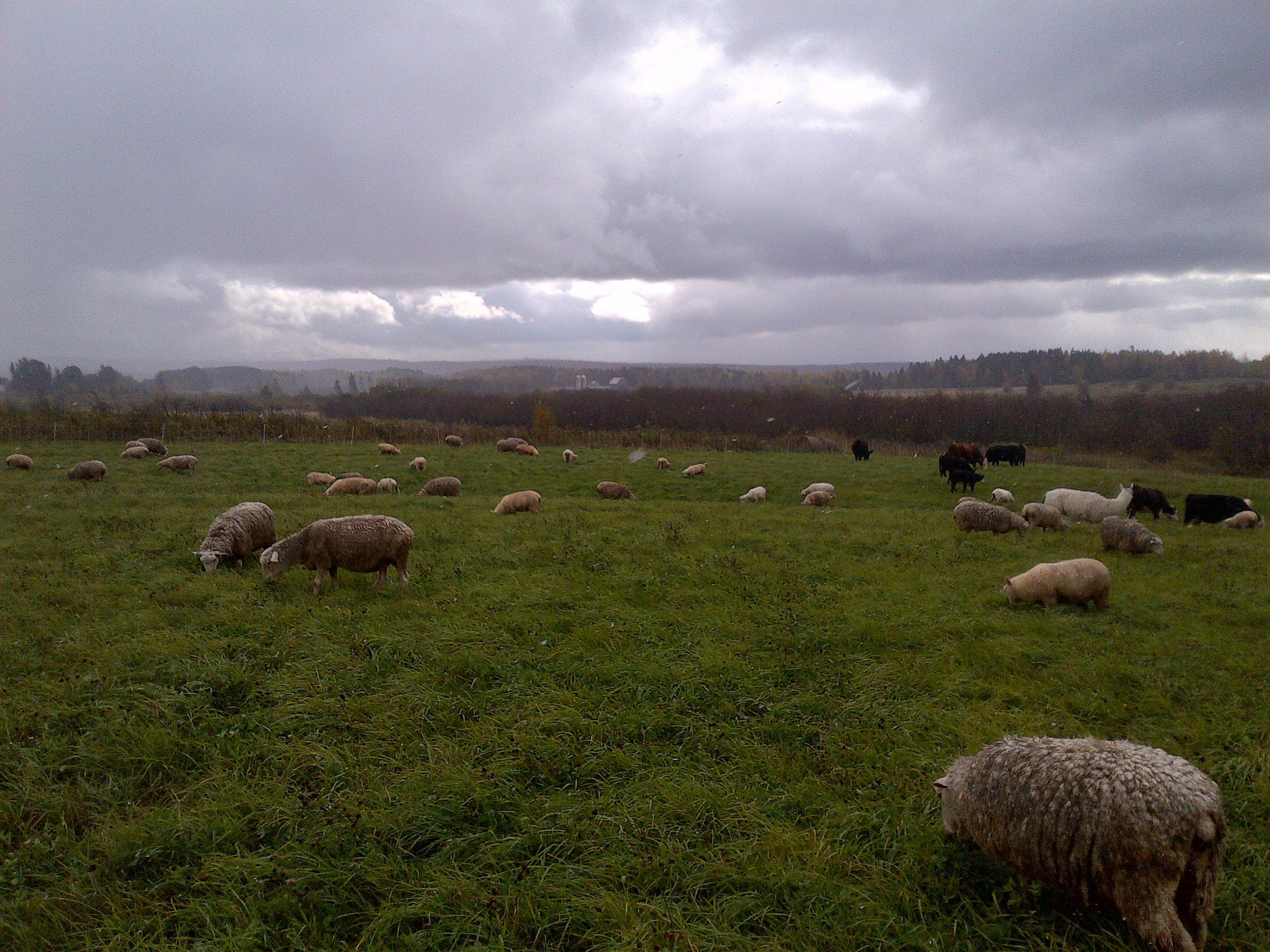
October 17: Lots of lush autumn grazing is still available, but an early-season snow flurry hints at the winter to come. (And the hints were well founded: We’ve had snow on the ground since Oct. 30.)


It’s a decent walk to the back of the farm – about 2,200 feet, or just under half a mile. I like it. It’s good exercise, and I think my brain works best at a walking pace.

In October, with the sheep and cattle grazing hard by the farm’s rear boundary, the trek became my daily constitutional. There was almost always electric fencing to move, or water to check on. In dry weather I could make the journey by tractor, but autumn’s heavy rains left the ground soft and muddy, so I substituted boot leather for diesel.

Somewhere around the half-way point, white-tailed deer forage on the far edge of a field — so comfortable with my regular commuting that they just stand and watch. Along the fencelines, flurries of fat little white-crowned sparrows rise from the grass. One day there were five or six eastern bluebirds along the backfield fence, the bright autumn sun turning their backs an electric blue. The day before, soft white snowflakes fell from a gunmetal sky.

About 10,000 years ago this country was sculpted by glacial meltwaters. Back then, a vast, turbulent river flowed east from the ancestor of Lake Huron towards the precursors of the Ottawa and St. Lawrence Rivers. The waters piled up sandbars that are now hills, depositing thick knolls of gravel and laying down dense layers of clay.

Now it takes a bit of imagination to see this an ancient glacial channel. Long-departed waters have scoured the land smooth, leaving a rounded landscape of grassed-over mounds and folds. About a century and a half ago, surveyors laid the groundwork for another transformation, parcelling a long-settled indigenous landscape (although one that must have looked like “untracked wilderness” to Europeans) into tidy 100-acre lots, each three-eights of a mile wide, five-twelfths of a mile long.

That survey line has wrought long-lasting change, displacing a people and laying the groundwork for forest to become field. For good or ill, I now walk within the boundaries of that survey, and I’m reminded how my relationship to land is an intimate one. This is, I hope, a lifelong partnership between farmer and land, even if the farmer is always fated to be the junior half of that partnership.

The land seems eternal, but it’s not unchanging. Even for us junior partners, it’s easy to make a misstep. To opt for tilling when the soil needs rest, for example, or to farm in a way that extracts fertility, rather than regenerates the health of the soil and the broader landscape. Making a gash in the earth seems quick and easy; but the work of soil building, of stewardship is incremental and difficult. To complicate factors, sometimes what turns out to be a misstep seems like the right choice at the time, when money is tight, or you really need that extra cut of hay for winter. In my life as a farmer, no less than as a husband, father, neighbour and citizen, it’s not always easy to discern the right direction, or where the next footstep should fall. Missteps are inevitable.

But I walk on, trying to move in the right direction for as long as my legs can carry me. With a New Year underway, I wish you the strength to continue your own journey, and the hope that it, too, is formed of many small, positive steps.

-30-

A birthday in the hayfield

IMG-20180705-00421

When I was a child, I hayed as a child. Motivated by a mix of obligation and avarice (I still remember the first crisp $20 note I received), I liked riding on the wagon and driving the tractors. I resented long, chaff-covered days tossing bales in a muggy mow.

When I was an adult, I put away those resentments. Something about baling your own hay (and not your parents’ or grandparents’) makes the task more appealing. In my mid-30s I could jog alongside the wagon and fling bales onto it. I took the worst jobs in the haymow, and then went across the road to help my neighbour.

Now, pushing into my mid-50s, not only is my grasp weakening (literally, thanks to arthritic knuckles) by my reach recedes, too. An early July birthday has much to recommend it, but haying season serves as a forceful reminder that you really are ageing — and in some ways, your own life follows the fevered, dusty arc of the bales you throw.

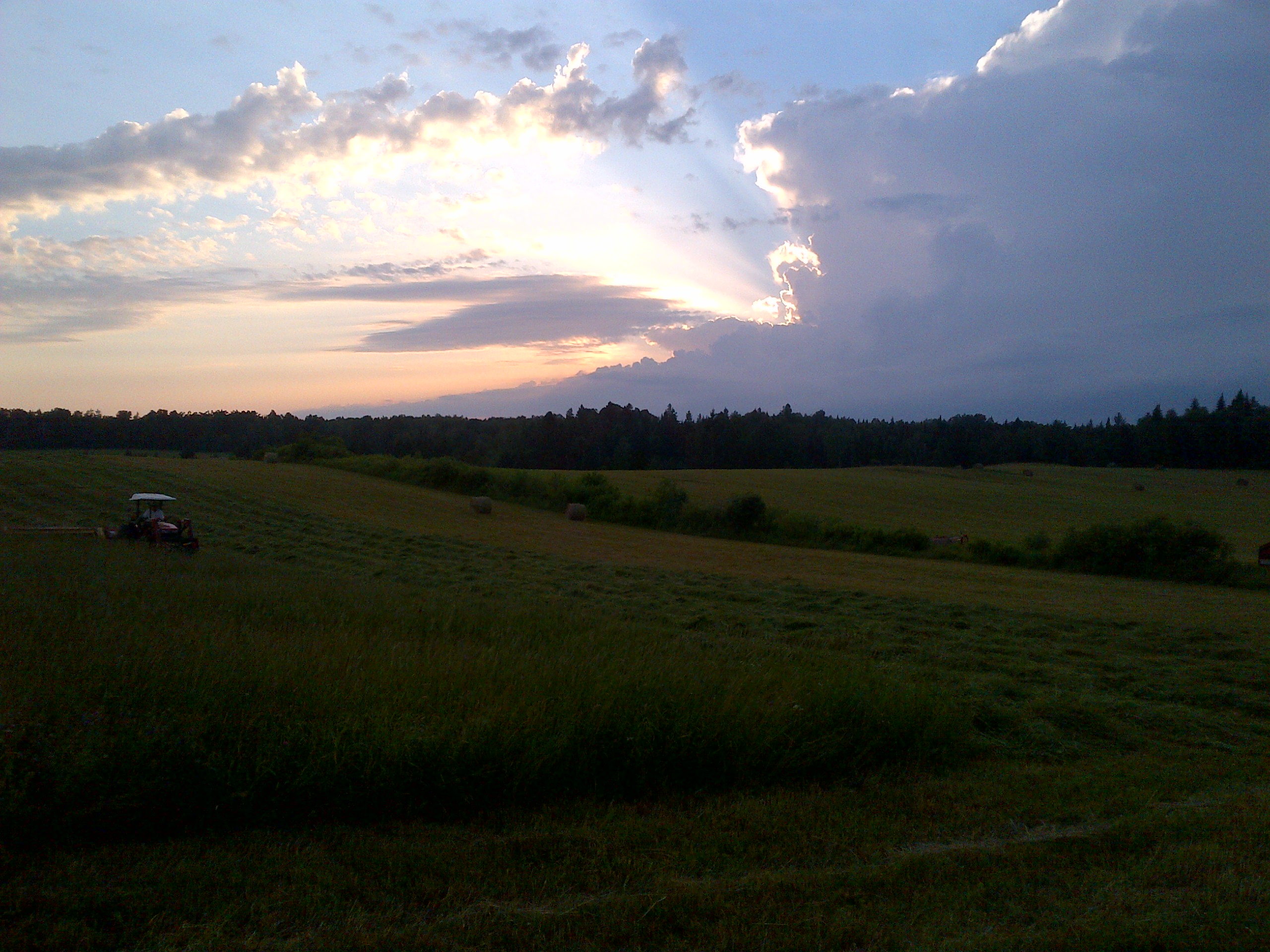
I’ve been in and out of hayfields at least since I was six or seven. Back then, I was dragging bales and wishing I was strong like the older men around me. For a while in my early teens, I relished the challenge and hated the job pretty much at the same time. Now, as the work becomes harder every year, I realize how much I love this time in the field. I love the urgency and the struggle against weather and time. I love the sense of accomplishment as the mow fills with square bales and round bales stud the fields. I love evenings alone on the tractor with the mower, watching the grass fall behind the machine while I listen to a baseball game on the radio. (Go Jays!) I especially love the sensations — not just the sweat and heat, but the way the sun sets and the twilight mist settles, cooling us as we put the last few bales in.

All flesh is grass, as the Old Testament says. I’ve been fortunate to live a life intimately connected with grass and the changing seasons, and I hope for another 20 years of hayfield urgency. But one day the task will slip from my hands, and I’ll remember haying the way an old athlete recalls his or her playing days.  During quiet moments, when the job is going well, I must savour this hayfield life.

-30-


The “Viking Syndrome” and your lawn

Hvalsey_Church

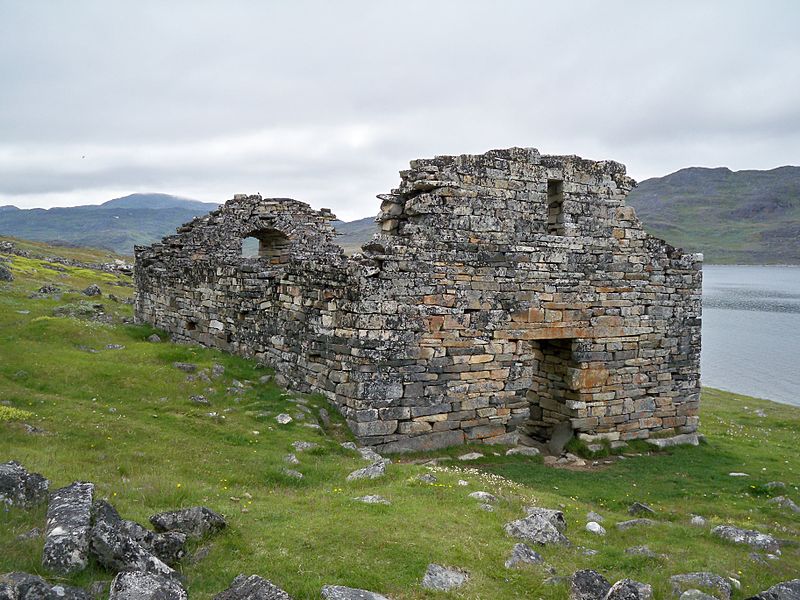
The ruins of Hvalsey Church, from Greenland’s mediaeval Norse settlement.

Ah, the placid greenery of gentle lawns and pastoral vistas. But grass didn’t get where it is today – that is, nearly everywhere — by being gentle and placid. Instead, Swiss botanist Hans Peter Linder argues grasses are the plant world’s Vikings – fearsome raiders who, as Linder and his co-authors write in a recent article in the Cambridge Philosophical Society’s Biological Reviews, are leafy “invaders from hell, bringing fire and hungry herbivores in their baggage.”

If your main contact with grass is limited to walking on it, you could be forgiven for underestimating the prickliness of the floral family variously known as Poacae or Graminae. Linder and co-authors Caroline Lehmann (like Linder, a faculty member with the University of Zurich), Sally Archibald (University of the Witwatersrand), Colin Osborne (University of Sheffield), and David Richardson (Stellenbosch University) argue grasses are among the planet’s floral overlords. Grass-dominated ecosystems cover up to 43 per cent of the earth’s land surface, and grass species are found on every continent, including the Antarctic. Grass is nearly ubiquitous wherever humans live, play, and farm.

It wasn’t always this way. Perhaps 80 million years ago, the ancestors of today’s grasses were bit players, “relatively unimportant forest-understory plants,” according to Linder. So how did this meek floral sideshow become one of the terrestrial environment’s main players? It succeeded with the help of what Linder calls “the Viking syndrome.”

Like the shipborne raiders of yore, grass was good at dispersing. It hitched a ride on – or in — animals and birds, was blown aloft on winds and perhaps even rafted across seas on flotsam. When those seeds landed in the right place, they could germinate quickly, and then fortify their position by producing more seed, or expanding through rhizomes. As a plant that tended to reproduce annually, but maintain the staying power of a perennial, grass could spread more rapidly than the trees that dominated the ancient landscape. Rapid generational change exploited the plant’s “phenotypic plasticity” – its ability to make genetic changes to cope with new conditions.

When a tree fell in the forest, grass was ready to step into the sunlight, and thrive. It spread along forest edges, and as dry spells weakened the forests, grasses seized more open ground. Whenever climate change or disaster thinned, toppled, burned or froze the vast treed canopies that covered the globe, grasses proved nimble opportunists. Over the past 25 million years or so (with the greatest strides coming only in the most recent millions of years) grasses won vast regions of the globe. They ruled over extensive ecosystems, dominating zones where precipitation is too meagre to support forests.

This expansion has been supported by a range of allies, including fire, grazing animals, underground fungal networks, and in the latest chapter, humans. As Linder points outs, grasses haven’t merely usurped resources from other species, they’ve literally transformed the landscape to the disadvantage of competitors.

Most grasses tolerate, and even encourage fire with their annual output of dead, papery leaves. When a fire sweeps through the sward, incinerating trees, seedlings, and forbs with overhead temperatures rising up to 700 degrees C, the sensitive growing buds of grass plants ride out the conflagration, nestled near the cooler, moister soil surface. Meanwhile seeds, shielded by a layer of insulating soil, emerge to take advantage of the ground the fire has cleared and fertilized with its ashes.

Extensive grasslands act as seasonal buffets for vast herds of grazing animals, and these creatures trample, eat, or scratch themselves on growing trees (helping to kill off the competition) while eating the grass. Being eaten usually means death for many other plants, but thanks to their low-level buds, grasses survive and even thrive under episodes of grazing. They have, as Linder says, “a biology enabling survival in the face of constant defoliation.”

Finally, there’s the bipedal animal – us humans. We’ve also spread grasses wherever we go, as lawns, playing fields, crops and pastures. Over thousands of years we’ve worked with fire and the axe to push back the trees. We’ve encouraged the growth of grass to draw the sort of wild animals we preferred to hunt, and later, we domesticated grazing animals. Now, ironically, humans are the major threat to natural grasslands (and in some cases, even agricultural grasslands). But that comes much later in the story.

Even so, we still live in an empire of grass, a domain far more extensive and longer-lasting than the Norse realm Linder compares it to. I like the way Linder’s paper confers a certain agency, even swagger to this crucial family of plants.  If we think much about plants at all, most of us see them as part of the scenery, passive recipients of whatever the weather and us animals dish out.

But if grasses are acting, as well as being acted upon, they’re also more than floral Vikings. One of the striking parts of the grass story is the way this once-minor plant has enlisted allies and enmeshed itself into the lives of so many other creatures. And while grasses have been, as Linder suggests, invasive and aggressive, the survival strategies of both grasses and grasslands include resilience, diversity, co-operation and even humility. I’ll be exploring these and other issues in future posts.

Grass has reworked the way the planet looks and operates. It has altered the flows of water, nitrogen, and carbon in and over the Earth’s surface. And it has facilitated the rise of human civilization.

“By all measures,” Linder says, “grasses have a significant and arguably disproportionate impact on global ecology…and human subsistence.” Compared to the impact of this green emperor,  the Vikings were bit players.

-30-

Of cranes and planes, and the structures that keep ’em flying.

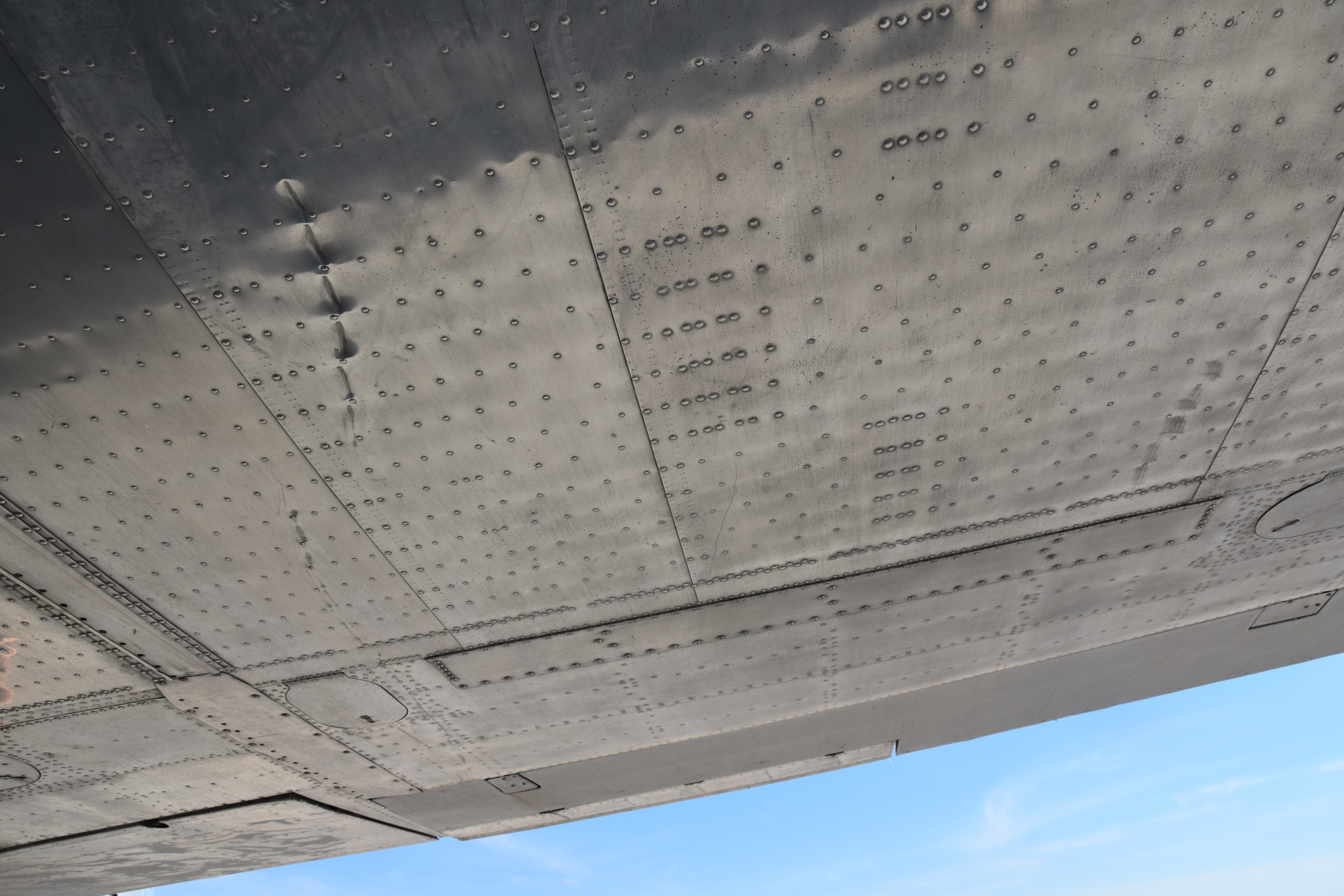
DSC_0341Last summer one of the few B-17 bombers still flying thundered into my local airport, and I joined a tour group poking around the old warbird. We threaded through its cramped confines, squinted in the sunshine glistening off its 72-year-old aluminum skin, and pondered questions of destruction, horror, and heroism.
Designed in the early 1930s, the U.S. B-17 is a throwback to an earlier era of flight. Yet the machine still has the sleek look of, say, a Canada Goose. (To my mind, the Lancaster – the bomber flown by many Canadians – is a little beefier and broader winged. More condor than goose.)

Now these machines, like the generation that flew them, are receding into history. Of almost 13,000 B-17s built during the war, only about a dozen are still capable of flight. The Lanc’s survival rate is even lower: about 7,400 were assembled (430 in Canada), but only two still take to the skies. Humans once erected a vast structure of factories and shops to build and maintain these craft. When the bombers were no longer needed, we dismantled that structure, parting out, scrapping or selling the aerial armada it supported.

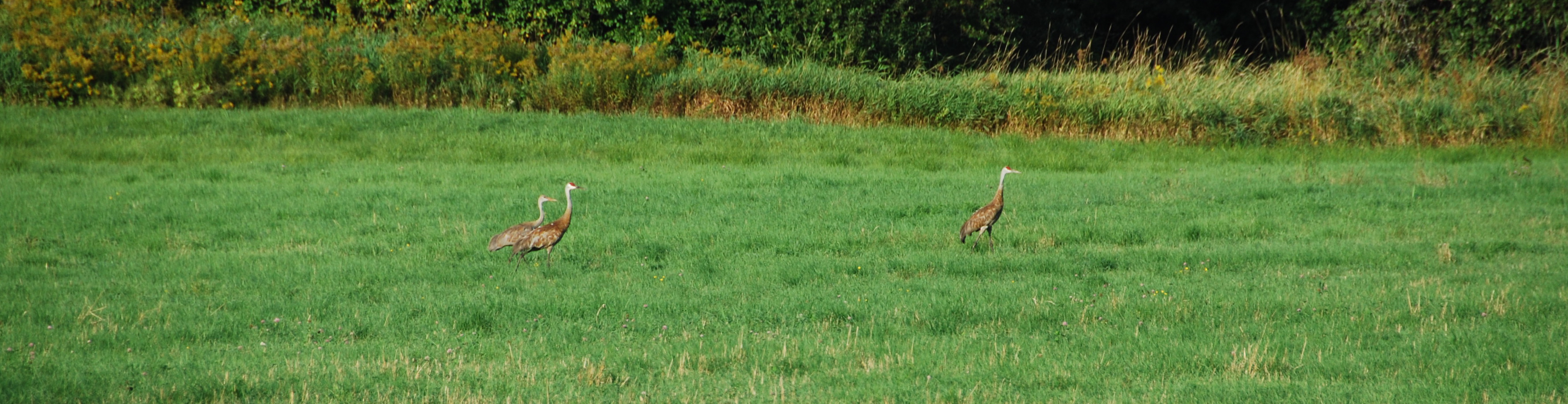
I thought of these bombers a few weeks ago, as the first wave of sandhill cranes swept over the farm. They were flying into a landscape soon to be pummelled by a couple of spring snowstorms and a nasty ice storm, yet they filled the air with their exuberant, rattling cries. The cranes, like the bombers, are noisy vestiges of an increasingly distant past. And like the bombers, it seemed that they, too, might fade into history.

Based on fossil evidence, the crane has existed in its present form for at least 2.5 million years. Through the millennia it survived the fall of North America’s great “megafauna,” (including the mastodon, oversized bears and giant sloths.) It adjusted to the ebb and flow of the ice ages. And it survived – just barely – the rise of a two-legged hunter with a striding gait and a talent for weapons.

As people and firearms spread across the continent, the crane went into a steep decline. During the 19th Century market hunting (that is, hunting wildlife and selling the carcasses as a commercial activity) took a heavy toll on a bird still known as the “ribeye of the sky.” Sandhill cranes virtually disappeared from Ontario, and only returned to the province’s skies in earnest during the 1980s.

Since then, the birds have shown a steady increase – so much so that they’ve become crop-eating nuisances for grain farmers along the migratory route. There are six regional sandhill crane populations in North America, and today there may be somewhere around 100,000 cranes in the eastern population, covering parts of Ontario, Michigan, Wisconsin and Minnesota.

DSC_0577

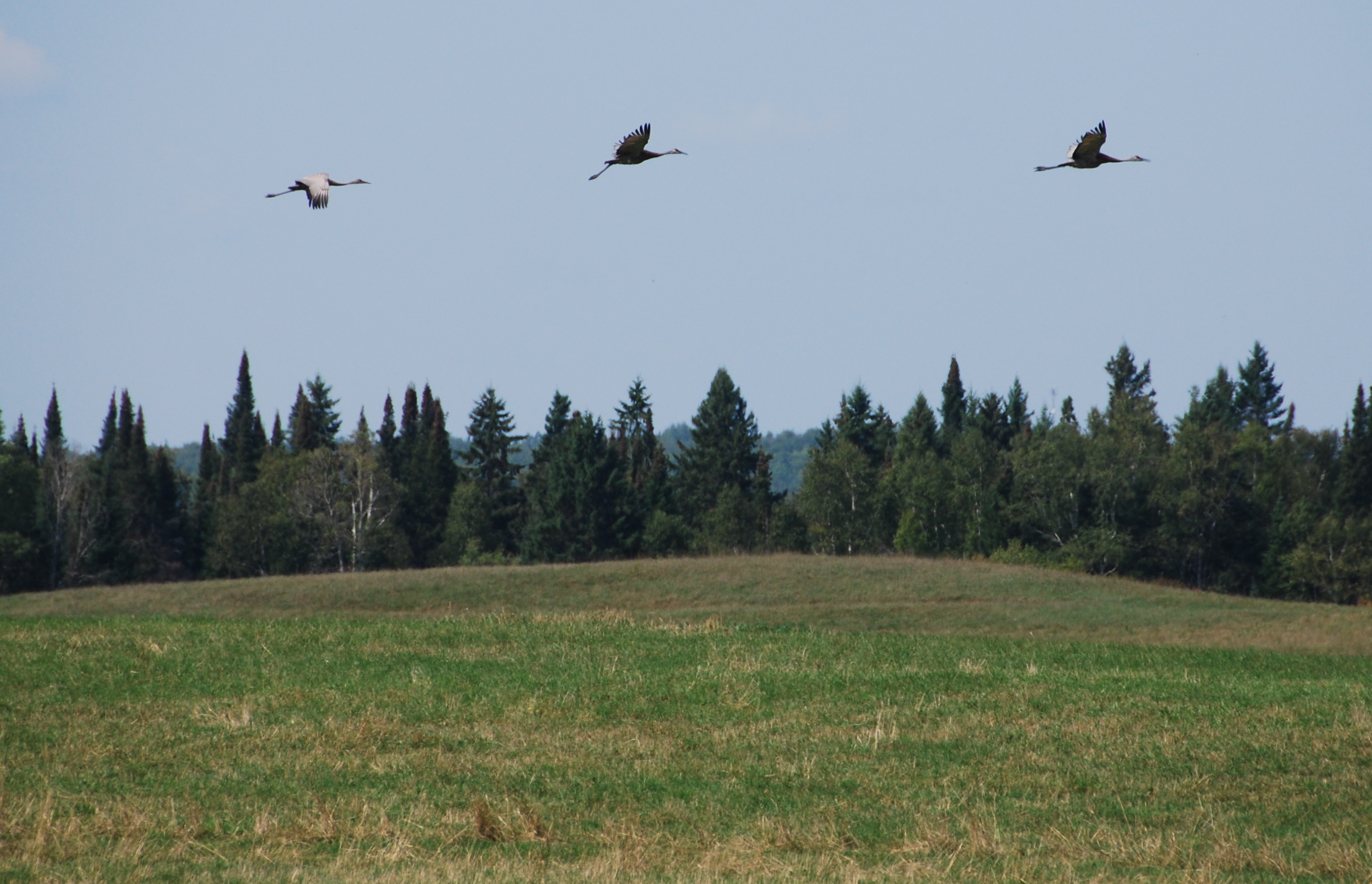
Sandhill cranes on the wing over my hayfields, September, 2015.

In 2011 I was lucky enough to write a story on the physics of flight for Cottage Life, and I interviewed Everett Hanna as he was studying sandhill cranes. Hanna teaches wildlife biology at Alberta’s Portage College, but as a doctoral student, he tracked cranes migrating from Manitoulin Island and the North Shore of Lake Huron (about 250 kilometres west of my farm.) He set up “rocket nets” – a net flung over unsuspecting cranes by missiles the research team fires – and waited for cranes to forage in the target zone. After the big birds were netted, he strapped GPS-transmitters to their legs, and released them.

The transmitters recorded impressive feats of flight. Migrating cranes ascend thousands of feet into the air, climbing thermal updrafts to altitudes as high as 12,000 feet. Then they stretch out their wings, and glide south in a long, controlled descent. With a strong tailwind, a gliding bird can coast 20 metres for every metre it descends. In 2009, one of Hanna’s transmitter-equipped cranes left Manitoulin Island, covering almost 1,000 kilometres in just 24 hours.

But if cranes are gifted flyers, they’re hardly prolific breeders – and that makes their recovery even more impressive. Sandhill cranes have the lowest reproduction rate of any North American game bird, averaging just 1.2 “colts” per breeding pair. Birds take at least three years to become sexually mature, and pairs are often unsuccessful until the parents are five to seven years old. As Hanna says the birds “are barely replacing themselves,” yet numbers continue to climb. As Hanna says, that makes their recovery “really marvelous – amazing, actually.”

The crane’s staying power demonstrates the resilience of nature, but it also stems from a wise policy choice made more than a century ago. By regulating hunting and other threats to most North American birds, the 1916 Canada/U.S. Migratory Birds Convention took the hunting pressure off the crane, and ensured the cranes would not go the way of the passenger pigeon. Slowly, the population stabilized, and then in the 1970s, it began to grow almost imperceptibly.

Now the recovery is so successful, there’s a sandhill crane hunting season in many U.S. jurisdictions, and talk – mostly among hunters and farmers – of the need for a season here. When I talked to Hanna a couple of years ago, he said he wouldn’t be surprised to see a hunt within the next decade or so. Given the right regulations, Ontario “could very easily make a (future hunting) opportunity available to recreational hunters, without having a negative impact on the population,” he said. But he warned the hunt won’t automatically prevent crop losses. Aside from the temporary disturbance from having hunters on the farm, “there would never be a situation where enough cranes would be harvested that you could see any difference in your fields.”

If you’ve seen the cranes’ courtship dance, or witnessed the spiralling ascent of dozens or hundreds of birds during the fall migration, you’ll likely agree: the skies, wetlands and grasslands are more beautiful thanks to this graceful creature. As Trevor Herriot writes in The Road is How, the crane “knows the long truths of a survivor.” It knows the value of bonding with a mate for decades, and of tender and devoted care for its colts. Its persistence, Herriot adds, “is a sign that the land is not as tamed and as tameable as we assume.”

DSC_0579

But it’s also a rare example of what can be accomplished when we exercise a little forbearance, a little self-discipline, in the form of thoughtful regulation. Government “red tape” doesn’t get a lot of good press these days, but the Migratory Birds Convention provides a sterling example of how regulation can curb our own worst impulses, and give other species the time and space they need to coexist. By taking hunting pressure off the crane, the convention and its associated laws allowed this bird to flourish, rather than end up as a stuffed exhibit in a museum.

Have we learned from this success? Maybe not. Earlier this month the U.S. Dept. of the Interior altered the way it interprets the convention, effectively loosening the regulatory burden on developers and resource companies. If the new policy holds, the U.S. federal government will be less likely to seek penalties against firms who, for example, unintentionally kill birds in oil spills.

The decisions we make and the structures we build make a difference. When the Second World War ended, we dismantled the structure that kept our wartime aircraft flying, and they disappeared from the skies. And that’s as it should be. (Even though that’s a wistful thought for airplane buffs.)

But we’ve also built structures like the migratory birds convention, structures designed to constrain our impact on the natural world. It’s hard work to get these things right. Often the results only come with much effort and patience. But the next time a politician tells you saving an endangered species is too hard, or too expensive, or will take too long, I say look to the sandhill crane. And let’s keep ‘em flying.

-30-