
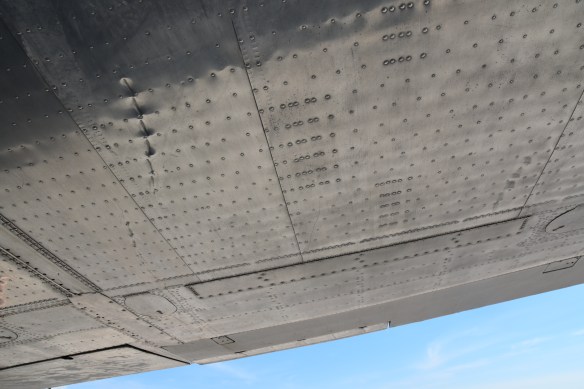
 Last summer one of the few B-17 bombers still flying thundered into my local airport, and I joined a tour group poking around the old warbird. We threaded through its cramped confines, squinted in the sunshine glistening off its 72-year-old aluminum skin, and pondered questions of destruction, horror, and heroism.
Designed in the early 1930s, the U.S. B-17 is a throwback to an earlier era of flight. Yet the machine still has the sleek look of, say, a Canada Goose. (To my mind, the Lancaster – the bomber flown by many Canadians – is a little beefier and broader winged. More condor than goose.)
Now these machines, like the generation that flew them, are receding into history. Of almost 13,000 B-17s built during the war, only about a dozen are still capable of flight. The Lanc’s survival rate is even lower: about 7,400 were assembled (430 in Canada), but only two still take to the skies. Humans once erected a vast structure of factories and shops to build and maintain these craft. When the bombers were no longer needed, we dismantled that structure, parting out, scrapping or selling the aerial armada it supported.
I thought of these bombers a few weeks ago, as the first wave of sandhill cranes swept over the farm. They were flying into a landscape soon to be pummelled by a couple of spring snowstorms and a nasty ice storm, yet they filled the air with their exuberant, rattling cries. The cranes, like the bombers, are noisy vestiges of an increasingly distant past. And like the bombers, it seemed that they, too, might fade into history.
Based on fossil evidence, the crane has existed in its present form for at least 2.5 million years. Through the millennia it survived the fall of North America’s great “megafauna,” (including the mastodon, oversized bears and giant sloths.) It adjusted to the ebb and flow of the ice ages. And it survived – just barely – the rise of a two-legged hunter with a striding gait and a talent for weapons.
As people and firearms spread across the continent, the crane went into a steep decline. During the 19th Century market hunting (that is, hunting wildlife and selling the carcasses as a commercial activity) took a heavy toll on a bird still known as the “ribeye of the sky.” Sandhill cranes virtually disappeared from Ontario, and only returned to the province’s skies in earnest during the 1980s.
Since then, the birds have shown a steady increase – so much so that they’ve become crop-eating nuisances for grain farmers along the migratory route. There are six regional sandhill crane populations in North America, and today there may be somewhere around 100,000 cranes in the eastern population, covering parts of Ontario, Michigan, Wisconsin and Minnesota.
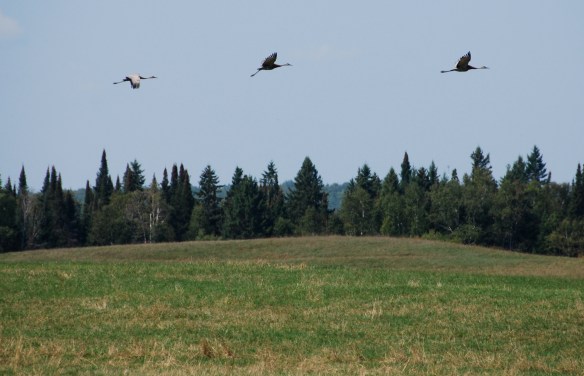
Sandhill cranes on the wing over my hayfields, September, 2015.
In 2011 I was lucky enough to write a story on the physics of flight for Cottage Life, and I interviewed Everett Hanna as he was studying sandhill cranes. Hanna teaches wildlife biology at Alberta’s Portage College, but as a doctoral student, he tracked cranes migrating from Manitoulin Island and the North Shore of Lake Huron (about 250 kilometres west of my farm.) He set up “rocket nets” – a net flung over unsuspecting cranes by missiles the research team fires – and waited for cranes to forage in the target zone. After the big birds were netted, he strapped GPS-transmitters to their legs, and released them.
The transmitters recorded impressive feats of flight. Migrating cranes ascend thousands of feet into the air, climbing thermal updrafts to altitudes as high as 12,000 feet. Then they stretch out their wings, and glide south in a long, controlled descent. With a strong tailwind, a gliding bird can coast 20 metres for every metre it descends. In 2009, one of Hanna’s transmitter-equipped cranes left Manitoulin Island, covering almost 1,000 kilometres in just 24 hours.
But if cranes are gifted flyers, they’re hardly prolific breeders – and that makes their recovery even more impressive. Sandhill cranes have the lowest reproduction rate of any North American game bird, averaging just 1.2 “colts” per breeding pair. Birds take at least three years to become sexually mature, and pairs are often unsuccessful until the parents are five to seven years old. As Hanna says the birds “are barely replacing themselves,” yet numbers continue to climb. As Hanna says, that makes their recovery “really marvelous – amazing, actually.”
The crane’s staying power demonstrates the resilience of nature, but it also stems from a wise policy choice made more than a century ago. By regulating hunting and other threats to most North American birds, the 1916 Canada/U.S. Migratory Birds Convention took the hunting pressure off the crane, and ensured the cranes would not go the way of the passenger pigeon. Slowly, the population stabilized, and then in the 1970s, it began to grow almost imperceptibly.
Now the recovery is so successful, there’s a sandhill crane hunting season in many U.S. jurisdictions, and talk – mostly among hunters and farmers – of the need for a season here. When I talked to Hanna a couple of years ago, he said he wouldn’t be surprised to see a hunt within the next decade or so. Given the right regulations, Ontario “could very easily make a (future hunting) opportunity available to recreational hunters, without having a negative impact on the population,” he said. But he warned the hunt won’t automatically prevent crop losses. Aside from the temporary disturbance from having hunters on the farm, “there would never be a situation where enough cranes would be harvested that you could see any difference in your fields.”
If you’ve seen the cranes’ courtship dance, or witnessed the spiralling ascent of dozens or hundreds of birds during the fall migration, you’ll likely agree: the skies, wetlands and grasslands are more beautiful thanks to this graceful creature. As Trevor Herriot writes in The Road is How, the crane “knows the long truths of a survivor.” It knows the value of bonding with a mate for decades, and of tender and devoted care for its colts. Its persistence, Herriot adds, “is a sign that the land is not as tamed and as tameable as we assume.”

But it’s also a rare example of what can be accomplished when we exercise a little forbearance, a little self-discipline, in the form of thoughtful regulation. Government “red tape” doesn’t get a lot of good press these days, but the Migratory Birds Convention provides a sterling example of how regulation can curb our own worst impulses, and give other species the time and space they need to coexist. By taking hunting pressure off the crane, the convention and its associated laws allowed this bird to flourish, rather than end up as a stuffed exhibit in a museum.
Have we learned from this success? Maybe not. Earlier this month the U.S. Dept. of the Interior altered the way it interprets the convention, effectively loosening the regulatory burden on developers and resource companies. If the new policy holds, the U.S. federal government will be less likely to seek penalties against firms who, for example, unintentionally kill birds in oil spills.
The decisions we make and the structures we build make a difference. When the Second World War ended, we dismantled the structure that kept our wartime aircraft flying, and they disappeared from the skies. And that’s as it should be. (Even though that’s a wistful thought for airplane buffs.)
But we’ve also built structures like the migratory birds convention, structures designed to constrain our impact on the natural world. It’s hard work to get these things right. Often the results only come with much effort and patience. But the next time a politician tells you saving an endangered species is too hard, or too expensive, or will take too long, I say look to the sandhill crane. And let’s keep ‘em flying.
-30-
 Empire of grass
Thank you for sharing such fabulous information! 🙂
I learned something today. Much appreciated, Uncle Tree
LikeLike
Thanks, very much, UT. I see we share an interest in these magnificent birds.
LikeLiked by 1 person